
The Faro Talmud
Colophon Ambiguities
and the Transmission of Sephardic Traditions in the Early Diaspora
By Shlomo Pereira1
Abstract
This study examines the history of Portugal’s first Hebrew press, established in 1487 with the printing of the Pentateuch, the first book ever printed in Portugal. The subsequent printing of Talmudic tractates represents an important but often overlooked chapter in Hebrew incunabula history. The fortuitous discovery in the early 20th century of the colophon of one of the Faro printings of the Talmud embedded in a sixteenth-century Italian binding provided conclusive evidence for establishing provenance of these works. At the same time, it left ambiguities as to the date of completion and the identity of the printer. After addressing these ambiguities, we trace echoes of these printers and printing activities, in Italy and the Ottoman Empire in the 16th century, thereby adding to the understanding of early Hebrew printing networks.
1. Introduction
The history of early Hebrew printing, started between 1469 and 1472 in Rome with the printing of the commentary on the Torah by R. Shlomo ben Yitzchak of Troyes (1040–1105), with the first dated Hebrew incunabulum being the 1475 printing in Reggio di Calabria of the same text. Having started in Italy, the technology of the Hebrew printing press then spread to Spain and Portugal.2
The emergence of Hebrew printing in fifteenth-century Portugal represented a critical yet understudied chapter in the history of Jewish book production and intellectual transmission.3 This is because, unlike in Italy and Spain where Hebrew printing lagged behind vernacular printing, in Portugal Hebrew printing assumed a pioneering role.
In fact, the first book ever printed in Portugal was a Hebrew book, the Pentateuch, in Faro in 1487. The second book printed in Portugal was also a Hebrew book, the commentary on the Torah by R. Moshe ben Nachman (1194-1270), printed in Lisbon in 1489. The most important Portuguese incunabulum in any language, the Almanach Perpetuum of R. Abraham Zacuto (1452-1515), was printed in 1496 in the Hebrew printing shop in Leiria. With versions in Latin and Spanish, it is considered the first non-Hebrew book to be printed in a Hebrew printing house. Overall, three Hebrew printing houses operated in Portugal, in Faro, Lisbon, and Leiria between 1487 and 1496. They produced fifteen Hebrew incunabula and one gothic, representing two-thirds of the incunabula printed in Portugal during this period.
The Hebrew printing shop established in Faro produced not only Portugal’s first printed book, the Faro Pentateuch, but also editions of several Talmudic tractates. While the Faro Pentateuch has received, and rightfully so, a fair degree of attention, the Talmud tractates printed in Faro deserve more attention than they have previously received. Their characteristics are unique among the earlier editions of the Talmud and their impact on later editions is significant.4 They are the focus of this study.
This study examines the material evidence of the Faro Talmud editions, analyzes the hermeneutic challenges posed by the fortuitous discovery of the colophon of one of these tractates, and traces their influence in the period of the early Iberian Jewish diaspora, in particular, in Italy.
2. On the Faro edition of the Talmud
2.1 The volumes of the Talmud printed in Faro
According to some sources, over twenty volumes of the thirty-seven extant tractates of the Talmud were printed in Faro.5 Of the few samples that have reached us today, however, only two tractates, Gittin [Divorce] and Berachot [Blessings], have been conclusively traced to Faro.
In addition, some have argued, although more tentatively, in favor of including in the Faro printings of the Talmud, several leaves of tractate Shevuot [Oaths] and of tractate Bava Metzia [The Middle Gate] hosted in the Jewish Theological Seminary in the United States of America and which are bound together with the leaves of the two tractates conclusively traced to Faro. The same is true about several fragments from several other tractates in the possession of the Cambridge University Library. Despite the similarities with the two tractates conclusively traced to the Hebrew printing shop in Faro, there are also differences in the size of the fonts and in the composition of the page.
2.2 Characteristics of the volumes of the Talmud printed in Faro
As typical of the Iberian editions of the Talmud, these printings include the Rashi commentary on the Talmud but omit the Tosefot [Additions]. The Tosefot are commentaries on the Talmud, primarily written by French and German Jewish scholars from the 12th to 14th centuries meant to supplement earlier commentaries, especially those of Rashi. Tosefot, today universally studied in the Jewish world, were generally not studied in the Iberian Peninsula at the time, where the custom was to supplement Rashi with the study of R. Moshe ben Nachman’s commentaries, which used a different methodology and had access to better manuscripts and geonic traditions.
The extant fragments of tractates Gittin and Berachot share many features, including fonts and layout. The text was printed on 26.0 cm by 21.0 cm paper. Each page features two columns of text with different numbers of lines. The inner columns, with up to thirty-four lines, feature the text of the Talmud while the outer columns, with fifty lines, feature the text of the Rashi commentary. The text of the commentary wraps around the main text to keep the two in tandem.
The same square fonts were used for the texts of the Talmud and the Rashi commentary. However, the font for the commentary is smaller to help the reader distinguish it from the text. Vowels are not included in either font size. In addition, there are no running titles and the chapter titles, although separate from the text, are in the same font size as the main text. The main difference between these and the Spanish editions of the Talmud which typically also included only the Rashi commentary is that the Spanish editions used cursive script for the text of the Rashi commentary.
2.3 Extant copies of the volumes of the Talmud conclusively attributed to Faro6
There are thirty-seven leaves of tractate Gittin in four institutions in Israel, the Netherlands, the United Kingdom, and the United States of America, and one leaf, incomplete, in the National Library of Portugal. In turn, there are thirteen leaves from Tractate Berachot in institutions in Israel and the United States of America and one incomplete leaf in the United Kingdom. There are also a series of small fragments of these two tractates in the Cambridge University Library.
3. A fortunate event: The finding of the colophon of Tractate Gittin
The circumstances that led to the identification of this specific printing of the Talmud as originating in Faro are very interesting in and of themselves, as well as in their far-reaching implications.
3.1 A fortuitous finding7
In a fortuitous but fortunate incident, in 1908, while working on the renovation of the binding of a sixteenth-century Italian Hebrew book, researchers at the University of Leiden in the Netherlands found leaves and fragments of tractate Gittin. One of these leaves included, in reasonable shape, its colophon page.
The Hebrew book in which these fragments were embedded in the cover, was part of a collection bequeathed to Leiden University by Levinus Warner (1618-1665). Warner worked in Istanbul for two decades as a Dutch diplomat. During that time, he amassed an extensive collection of over 1,000 manuscripts in Arabic, Turkish, Persian, Hebrew, and Greek.
Although most items in Warner’s collection were in Arabic, there was an important number of Hebrew works: seventy-three manuscripts and two hundred and eighteen printed books, some rare, others much less so. It was one of these books, not such a rare one, that the researchers turned to in 1908 for restoration of its binding. The book was Ateret Zekeinim [The Crown of the Elders], by R. Yitzchak Abarbanel (1437-1508).
R. Yitzchak Abarbanel,8 or Don Yitzchak Abarbanel as he is usually referred to in a mix of respect and reverence, was a renowned Portuguese Jewish statesman, financier, philosopher, and biblical commentator. He served Portuguese King Afonso V in the highest positions and fled to Spain in 1483, accused of conspiring against his successor King João II. DonYitzchak Abarbanel left Spain after the 1492 expulsion, and then settled in Italy, in Naples, Messina, Corfu, and Venice. He served as treasurer to several monarchs, helped ransom Jewish captives, and led several communities through turbulent exiles. He wrote influential commentaries on the Bible and works on Jewish thought. His intellectual legacy bridges the worlds of diplomacy and religious scholarship.
Ateret Zekeinim is a commentary on Exodus 23:20–24:18, composed in Lisbon, around 1465–1475. It is DonYitzchak Abarbanel’s first completed literary work and focuses on themes of prophecy, divine providence, and the uniqueness of the Jewish people, presenting pointed questions and critical analysis of earlier commentators before offering his own interpretations.
This edition of Ateret Zekeinim, its editio princeps, that is its first edition, was printed in Sabbioneta, Italy, in 1557 by Tuviah ben Eliezer Foa in the Hebrew printing shop he ran from 1551 to 1559. This printing house had a significant and innovative output, including as their inaugural printing in 1551, the first printed edition of DonYitzchak Abarbanel’s commentary on the Book of Deuteronomy, Mirkevet HaMishnah [Vehicle of the Repetition].
For the cover of this copy of Ateret Zekeinim, the original bookbinder had used printed leaves from a Hebrew work. This was not an unusual procedure. In fact, the covers of printed books at this historical stage were essentially pasted leaves and it was customary to use previously printed paper. This was done recklessly by many non-Jewish bookbinders with parts of Hebrew books that had been confiscated and were often printed on high quality paper. It was also done by Jewish bookbinders with previously used and then discarded printed paper, as was the case here.9
As it turns out, the cover of this book was formed by parts of a printing of Talmudic tractate Gittin in a format that caught the attention of the expert restorers working on it. It was clearly an old edition of the Talmud given its use in a 1557 binding. It was also an edition using only square characters of different sizes, using the smaller types for the Rashi commentary, something that was rather unique. It did not, however, feature vowels in either font, or titles for the different sections and it omitted the Tosefot. All of these were telltale signs of an old printing of Iberian origin.10
3.2 Far-reaching implications
In total, ten fragments were rescued through a careful process of deconstructing the cover of this printed copy of Ateret Zekeinim: two whole leaves and eight half leaves. Two of the eight half leaves were duplicates of the upper half of the two full leaves.
Aside from its intrinsic importance, the finding of these fragments turned out to have far-reaching implications as one of the full leaves was the end leaf and included the colophon. This allowed for a conclusive identification of the place of printing as Faro. The colophon of tractate Gittin, aside from proving the provenance of the then extant fragments of tractate Gittin, also provided a clear benchmark to identify the provenance of the surviving parts of tractate Berachot and to dismiss a direct connection to Faro of other parts or fragments of other Talmudic tractates.
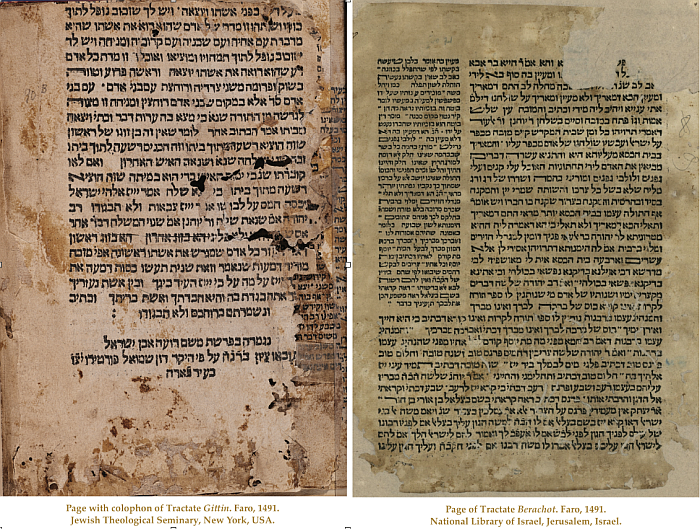
4. The colophon of Tractate Gittin: one answer and several questions
The finding of the colophon of tractate Gittin provided a conclusive answer to the question of the provenance of this incunabulum, while at the same time opening the door to important questions about the identity of its printer and the date of its completion.
4.1 The colophon
The colophon of this edition of tractate Gittin reads as follows:
Completed [the week of] parsha ‘from the hands of the Mighty One of Yaakov, from there he sustained the rock of Israel,’ in the year of ‘they shall come to Zion with song,’ by the noble Don Shmuel Porteiro, may G-d protect him, in the city of Faro.”
While the colophon leaves clear the place where the incunabulum was printed. It also left open questions about the identity of the printer and the date of printing.
4.2 Who was Don Shmuel Porteiro?
In the colophon of tractate Gittin, the printing is attributed to “the noble Don Shmuel Porteiro” of Faro. The question is whether or not this person and “the noble Don Shmuel Gacon” of the colophon of the Faro Pentateuch are the same person.11
The consensus that has emerged in the literature is that Shmuel Gacon and Shmuel Porteiro are likely the same person. The similarity of the character types used in the Faro Pentateuch and these editions of the Talmud also suggests this is the case.12
Using Portuguese documentation from the time, the term ‘porteiro’ (literally "doorkeeper" or "bailiff") is known to refer to a position in the financial administration of the realm. The existence of this position in the organized Jewish communities is recognized in the Ordinances of D. Afonso, a general codification of Portuguese law completed in 1446/1447 during the reign of King Alfonso V.13 While the community’s rabbi oversaw the administration of justice on matters amongst Jews, the ‘porteiro’ served by royal appointment as an adjunct in charge of implementing the judgments, particularly financial judgments, property seizures, and garnishing of assets.
The hypothesis is that Shmuel Gacon may have assumed the position of ‘porteiro’ after the printing of the Faro Pentateuch, having adopted at some point thereafter the name Shmuel Porteiro.
4.3 When was the printing completed?
The colophon of tractate Gittin indicates the printing date. It was completed on the week of the Torah portion including the verse “from the hands of the Mighty One of Yaakov, from there he sustained the rock of Israel” (Genesis 49:24), which is in the Torah portion of Vayechi which covers Genesis 47:28-50:26.
The year is indicated by the gematria of the word b’rina [with song] in the verse “they shall come to Zion with song” (Isaiah 51:11). The word b’rina, spelled in Hebrew with the letters bet, reish, nun, hei, suggests either 5252 or 5257 depending on how the final letter hei, which has a numerical value of five, is interpreted. As bet, reish and nun have the numerical values of two, two hundred, and fifty, respectively, the first three letters indicate 252.
All hinges on the role the final letter hei plays in the specification of the dating. If hei refers to the millennia, it would be 5252 or 1491, and if hei is to be added to the date, with the millennia remaining implicit, then it would be 5257 or 1496. If we follow the date of 5252, the week of the Torah portion of Vayechi would start on the 10th of Tevet corresponding in the Julian calendar to the week of December 11, 1491. If we follow the date 5257, the week of the Torah portion of Vayechi would start on the 6th of Tevet and would correspond in the Julian calendar to the week of December 17, 1496.14
The 1491 vs. 1496 dating remains contested. Some scholars favor 1491 while others point to paleographic evidence suggesting 1496.15 Despite some expert opinions to the contrary, we do not find the date of 1496 plausible. The Decree of Expulsion was signed on December 5, 1496, requiring all Jews to leave Portugal by October 1497 or convert. If the Gittin colophon date is December 17, 1496, it would have been printed just 12 days after the decree. Around this time, a decree stipulated the beginning of the dismantling of the Jewish community in Portugal, which included confiscating all Hebrew books. We would expect maybe, as in other cases in the early printing, to find some reflection of these events in the colophon. Instead, with its quotes, the colophon almost sounds an optimistic note.
Furthermore, as discussed elsewhere,16 the consideration of instances with similar ambiguities in Iberian Hebrew manuscripts and in other Iberian Hebrew incunabula strongly supports the early dating. For example, applying the same principles leading to the late dating of tractate Gittin another Portuguese Hebrew tractate printed in Leiria, the Book of Proverbs with two popular commentaries, would lead to the extremely unlikely completion dating of June 1497. To be specific, this Hebrew incunabula from Leiria uses exactly the same word b’rina from exactly the same verse Isaiah 51:11 to indicate the year of completion.
The Decree of Expulsion of the Jews from Portugal was enacted on December 5, 1496. It stipulated that all Jews not willing to convert had ten months, until the end of October 1497, to leave Portugal through three pre-assigned ports, Lisbon, Porto, and Setúbal. It became abundantly clear that there was no intention of allowing Jews to depart with a first round of forced conversions in March 1497 and with the legislation in May 1497 that provided protection to those Jews who would convert.
Ultimately, as the end of October 1497 drew closer, no ships were available in any of the three ports formally assigned in the decree of expulsion itself. Thousands of Jews gathered in Lisbon, the only port where ships would be purportedly waiting. Standing under the elements, the Jews faced hunger, conversionary speeches, and, ultimately, forced conversion.
In retrospect, it is easy to see signs of this strategy of forced mass conversions from the moment of the promulgation on December 5, 1496, of the Edict of Expulsion. In fact, on December 15, 1496, a mere ten days after this decree, laws were enacted meant to immediately start dismantling Jewish communal institutions, religious institutions such as synagogues and schools, but also social institutions such as charities, hospitals, and even cemeteries. Communal property and its contents, including Hebrew books, were to be confiscated. Jewish life and organization at a communal level was to end immediately. At about the same time, and although the specifics of the legislation and its date are not known, ritual objects and Hebrew books in the private possession of individual Jews, were systematically confiscated by the authorities.
A dating of 1497 is inconsistent with the immediate complete dismantling of the Portuguese Jewish community after the decree of expulsion, several widespread episodes of mass forced conversion, and confiscation of both community and privately owned Hebrew books.17
4.4 A gap in time?
Finally, it has been noted that there is a wide temporal gap between the printing of the Pentateuch in 1487 and of the Talmud in 1491, or 1496 if we were to accept the later dating. Although such gaps are not uncommon when considering Hebrew incunabula production in general, this is a noticeable gap, given that this time was a rather active period of Hebrew printing in Portugal.
A possible explanation is that the books printed in Faro during this period did not stand the test of time, having been lost or destroyed. Specifically, the lost incunabula could conceivably include editions of other tractates of the Talmud printed in this interim period, maybe even some if the twenty plus tractates some researchers argued were printed in Faro. Regardless, any reference on this matter is, at this point, merely speculative.
5. Echoes of the Faro printings of the Talmud and of the Faro printers
It is not known what exactly happened during the tragic events of 1496/97 to Shmuel of the Hebrew printing shop of Faro. It is not known if he was still in Portugal at that time or if he had left the country upon the closing of his Hebrew printing shop, likely a few years before. There is, however, some information about the family in the period that follows.
5.1 An Italian connection: Pesaro18
It is believed that, when the family left Portugal, at least one of his children settled in Pesaro, Italy. It is also believed that they took part of the printing equipment used in Faro with them. A distinguishing feature of this press in Pesaro was that it had elements in only two sizes, as with the Talmud printings from Faro, but unlike Faro where vowels were not included, in Pesaro vowels are included in the large types.
Indeed, it has been argued that the fragments from Tractate Shevuot and Tractate Bava Metzia of the Talmud hosted by the Jewish Theological Seminary in New York share some important characteristics with the texts of Tractate Gittin and Tractate Berachot, which have conclusively been traced to Faro. Given the similarities and the differences, it is conjectured these editions although no longer from Faro were nevertheless the work of the Gacon/Porteiro family already printing in Italy.
More importantly, in the same period, R. David Porteiro, who is presumed to be a son of Don Shmuel, was active with the Italian printing house of Gershon Soncino at Pesaro, especially in the printing of several Talmudic tractates. Gershom Soncino (c.1460–1534) established his press in Pesaro from 1507–1520, where he printed at least 23 tractates of the Talmud. He was previously active in Soncino, Casal Maggiore, Brescia, Barco, Fano, and later moved to Rimini, Ortona, Salonica, and Constantinople.
R. David Porteiro is explicitly named, either as a proofreader or as a patron, in the colophon of five tractates published between 1511 and 1515 in Pesaro by the Soncino printing house. These five tractates, in a universe of twenty-three tractates published by the Soncino family in Pesaro, are Shevuot, Sukkah, Moed Katan, Rosh HaShanah, and Eruvin. By participating in these printings of the Talmud, R. David Porteiro would merely be following in the footsteps of his father.
It has been conjectured, however, that the connection may be deeper and that there is a direct link between the printing types used by the Soncino press in Pesaro and the types used in the printings of the Talmud in Faro. The matter remains unresolved.
Regardless, R. David Porteiro is likely to have contributed to the use of the old Sephardic sources to correct or update the Talmudic texts used in earlier versions printed in Italy and which were based on less reliable manuscript sources. Perhaps, he even had in his luggage not only the Faro editions of the tractates, but also old manuscripts, all typically regarded as being more reliable sources.
5.2 A likely Italian connection: Sabbioneta
As detailed above, in 1908, researchers at the University of Leiden, in the Netherlands, turned to the book Ateret Zekeinim, an early work of R. Yitzchak Abarbanel printed in Sabbioneta in 1557, in order to restore its binding. As it turned out, the cover of this printing of this copy of Ateret Zekeinim was formed by parts of the Faro printing of Talmudic Tractate Gittin.
Of particular relevance in this context are the findings of duplicate leaves. The use of duplicate leaves of the tractate Gittin printed in Faro in the binding of Ateret Zekeinim suggests more than a casual link between this printing house in Sabbioneta and the printing house in Faro. It could indicate that a part of the stock of paper of the Faro Hebrew printing shop, including previously printed leaves, had been deliberately taken to Italy.
5.3 A tentative Italian connection: Ancona19
The episode of the Martyrs of Ancona was an incredibly significant and far-reaching event. The tragedy occurred in 1555–1556 under Pope Paul IV, the first pope of the Counter-Reformation. In the aftermath of much papal hostility towards Jews in general and, in particular, toward conversos who had returned to Judaism, twenty-four Portuguese conversos, were arrested for refusing to convert back to Christianity. Some were burned at the stake, others hanged.
This event sent shockwaves among European Jews, triggered protests, and a commercial boycott was called and implemented by the commercial empire of Dona Gracia Nasi (1510-1569). The boycott generated heated debates among rabbinical scholars. It ultimately failed, but it demonstrated Jewish economic power and solidarity.
But what could the connection be to the Hebrew printers of Faro? Two of the twenty-four martyrs named are identified as Yosef Gacon and Shmuel Gacon.20 We do not have direct evidence that these are members of the family of Hebrew printers from Faro. But we do know that all the martyrs had moved to Ancona from Portugal in the aftermath of the events of 1496/97. We also know that Gacon was not a family name common in the Portuguese records from late 15th century.
5.4 Ottoman connections
Echoes of the Gacon family are also later to be found in Constantinople, a city which became a major center for Hebrew printing after 1492/1497, with refugee printers from Spain and Portugal establishing presses alongside Italian printers.
A certain R. Yitzchak Gacon is known to have lived in Constantinople, although not to have been engaged in printing activities. He is referred to in Mashrei Katrin [Untier of Knots], a kabbalist book by R. Abraham ben Eliezer (c.1460-c.1528), a scholar active in Constantinople and in Jerusalem, and a brother-in-law of R. Abraham Zacuto (1452-1515).21
In addition, a certain R. Yosef Gacon is mentioned in Manot HaLevi [Gift from Levi], a commentary on the Book of Esther by R. Shlomo ben Moshe HaLevi Alkabetz (c.1500-1575). R. Alkabetz was a kabbalist and poet born in Salonica, who eventually settled in Safed and who is best known for composing the liturgical hymn Lecha Dodi [Come my Beloved]. He wrote Manot HaLevi in 1529 as a gift to his father-in-law on the occasion of his wedding.22
6. Conclusion: The Faro Talmud in the Context of Early Hebrew Printing
The Hebrew printing enterprise in Faro occupied a unique position within the broader landscape of fifteenth-century Jewish book production. Operating between 1487 and approximately 1491, the press of Shmuel Gacon/Porteiro not only produced Portugal's inaugural printed work but also generated a distinctive corpus of Talmudic editions whose characteristics reflect the particular intellectual and material conditions of Iberian Jewish communities on the eve of expulsion.
The textual features of the Faro Talmud editions—their inclusion of Rashi commentary without Tosafot, their exclusive use of square Hebrew fonts in two sizes without vocalization, and their distinctive page layout—position these printings within a specifically Sephardic hermeneutic tradition. They also reflect pedagogical priorities that privileged the methodology of Nachmanides over the Franco-German approaches, documenting in material form the intellectual divergence between Ashkenazic and Sephardic approaches to Talmudic study in this period.
The fortuitous twentieth-century recovery of the tractate Gittin colophon from a sixteenth-century Italian binding exemplifies the fragmented and contingent nature of evidence for early Hebrew printing. The colophon's chronological ambiguities—particularly the contested dating of 1491 versus 1496, illuminate methodological challenges inherent in interpreting gematria dating conventions, while its resolution in favor of the earlier date reveals the necessity of contextualizing bibliographic evidence within the broader historical circumstances of Portuguese Jewish persecution and expulsion. The systematic confiscation of Hebrew books and dismantling of communal institutions immediately following the December 1496 expulsion decree renders implausible any printing activity in the final weeks of 1496, thereby supporting the 1491 completion date on both paleographic and historical grounds.
The subsequent trajectories of the Gacon/Porteiro family and their printing materials through the Mediterranean Jewish diaspora demonstrate the continuity of professional networks and intellectual resources across geographic displacement. David Porteiro's documented collaboration with Gershom Soncino's Pesaro press between 1511 and 1515, particularly in the production of five Talmudic tractates, represents a direct transmission mechanism through which Iberian textual traditions and potentially superior manuscript sources informed Italian Hebrew printing. The presence of duplicate leaves from the Faro Gittin edition in the 1557 Sabbioneta binding of DonYitzchak Abarbanel's Ateret Zekeinim suggests that physical printing materials migrated alongside human agents, creating material continuities between pre- and post-expulsion Sephardic book culture.
The fragmentary survival of the Faro Talmud editions—thirty-eight leaves of Gittin, fourteen leaves of Berachot, scattered fragments in multiple repositories—reflects both the systematic destruction of Hebrew books during the Portuguese expulsion and the subsequent recycling practices that paradoxically preserved these materials within Christian, and occasionally Jewish, bookbinding. This pattern of survival positions the Faro editions within the broader phenomenon of the "European Genizah," highlighting the necessity of interdisciplinary methodologies combining codicology, book history, and archival reconstruction for recovering the material record of early Jewish print culture.
Finally, the recovery of the Faro Gittin colophon from the 1557 Sabbioneta binding of Don Yitzchak Abarbanel’s Ateret Zekeinim represents far more than a fortunate archival discovery. It exemplifies the paradoxical preservation and fragmentation that characterized Sephardic intellectual culture in the aftermath of the traumatic upheaval of the 1490s. The serendipitous encounter between a Portuguese printing’s colophon and a prestigious Portuguese refugee’s work, bound together nearly seventy years after the expulsion, encapsulates multiple layers of diaspora narrative.
Don Yitzchak Abarbanel, having fled Portugal to Spain in 1483 and subsequently to Italy after the 1492 expulsion, composed the Ateret Zekeinim in Lisbon during the 1465-1475 period—decades before both the Faro press and his own exile. When this commentary was finally committed to print in Sabbioneta in 1557, its bookbinder incorporated fragments of a Hebrew press that had operated in Abarbanel’s native land precisely during the interval when the distinguished statesman-scholar was establishing his intellectual authority in Jewish thought.
The circumstance that this very binding preserved evidence of Faro’s printing activities speaks to the hidden continuities within rupture: while the Spanish and Portuguese expulsions sundered communities and displaced persons, they also scattered both human knowledge and the physical remnants of intellectual production, manuscripts, printing matrices, bound books, across the Mediterranean world. The Gittin fragments embedded in Abarbanel’s Ateret Zekeinim binding thus function as involuntary testimony to the forced migrations and involuntary encounters that characterized Iberian Jewry’s reconstruction of cultural memory and textual authority in diaspora.
1 Professor Emeritus, College of William & Mary, VA, USA, Rabbi, Chabad of Virginia, VA, USA. He is the co-author with R. Eli Rosenfeld of the recently published Monuments of Paper and Parchment: Hebrew Printing in Portugal in the late 15th century. Chabad Portugal Press, 2025.
2 For a general overview of early Hebrew printing see: Adri Offenberg, Hebrew Incunabula in Public Collections: A First International Census (Nieuwkoop: De Graaf Publishers, 1990); Adri Offenberg, Catalogue of Books printed in the 15th Century now in the British Museum. Part XIII: Hebraica. (Hec & de Graaf, Goy, 2004); and, Chaim Dov Friedberg, History of Hebrew Typography in Italy, Spain-Portugal, and Turkey (Tel Aviv: Bar-Juda, 1956).
3 For details and sources about the history of Hebrew printing in Portugal see, for example, Artur Anselmo, Origens da imprensa em Portugal (Lisboa: Imprensa Nacional, Casa da Moeda, 1981) and João Oliveira, “A Produção de incunábulos hebraicos em Portugal nos finais do século XV,” In O livro e as interações culturais judaico-cristãs em Portugal no final da Idade Media edited by Luis Urbano Afonso and Paulo Mendes Pinto (orgs.) (Lisboa: Cátedra de Estudos Sefarditas Alberto Benveniste: pp.119-144, 2014).
4 In the early stages of Hebrew printing, we know of ten tractates printed in Italy and nine tractates in Spain. For more information on these editions see, for example, Offenberg (1990) and Marvin J. Heller, Earliest Printings of the Talmud, pp. 61-78 in Printing of the Talmud: From Bomberg to Schottenstein, edited by Sharon Mintz and Gabriel Goldstein, (New York: Yeshiva University Museum, 2005).
5 See, for example, A.M. Habermann, The History of the Hebrew Book (Jerusalem, 1968) and C.B. Friedberg (1956). Habermann estimated approximately 20 or more tractates attributed to Faro, while Friedberg lists 22. More recent research points to a much more conservative number. Regardless, only two tractates have been conclusively traced to Faro."
6 See, for example, the listings under the Incunabula Short-Title Catalogue at https://data.cerl.org/istc/.
7 See, for example, E. Slijper, Eine portugiesische Talmud-Ausgabe vor 1500. Zeitschrift für Bücherfreunde 12 (5). pp. 207-209, 1908, and S. Seeligmann, Ein portugiesischer Talmuddruck, Unknown. pp. 16-19. 1908.
8 On his life and contributions see, for example, Cedric Cohen Skalli, Don Isaac Abravanel: An Intellectual Biography (Brandeis University Press, 2020) and Eric Lawee, Isaac Abarbanel’s Stance Toward Tradition: Defense, Dissent, and Dialogue (SUNY Press, 2001).
9 This discovery was part of what scholars call the "European Genizah" - thousands of Hebrew manuscript and printed book fragments recycled into bookbindings throughout Europe. Over 16,000 fragments have been identified. See, for example, Simcha Emanuel, “The European Genizah: Its Character and the History of Its Study,” Materia Giudaica, vol. 24 (2019), pp. 587-624 and European Genizah: Newly Discovered Hebrew Binding Fragments in Libraries and Archives in Europe, edited by Andreas Lehnardt. (Leiden: Brill, 2017).
10 See again Heller (2005).
11 The colophon of the Faro Pentateuch reads as follows: “Concluded here in Faro on the 9th of the month of Tammuz, in the year of ‘praise the righteous for he is good’ by order of the noble and elevated Don Shmuel Gacon, may G-d protect him.”
12 See, for example, Anselmo (1981); Adri Offenberg (2004); Konrad Haebler, Typographie ibérique du quinzième siècle: Reproduction en facsimile de tous les caractères typographiques employés en Espagne et en Portugal jusqu’à l’année 1500. Avec notices critiques et biographiques. (The Hague: Nijhoff, 1901); and Tiago Moita, O Livro Hebraico Português na Idade Média (Lisboa: Faculdade de Letras da Universidade de Lisboa, 2017).
13 José Domingues (2007). Ordenações Afonsinas. Três Séculos de Direito Medieval (1211-1512). Tese de Doutoramento (Universidade de Santiago de Compostela, 2007) and Mário Júlio de Almeida Costa. “Ordenações Afonsinas.” História do Direito Português (5ª ed.), pp. 305–312. (Lisboa: Almedina, 2019).
14 See, for example, https://abdicate.net/cal.aspx for accurate calendar conversions of Hebrew dates to Gregorian or Julian dates.
15 For the strongest paleographic defense of the later dating see Malachi Beit-Arié, Hebrew Codicology: Historical and Comparative Typology of Hebrew Medieval Codices Based on the Documentation of the Extant Date Manuscripts in Quantitative Approach (Pre-Publication, Internet version 0.3, 2014).
16 See R. Shlomo Pereira “On the ambiguous dating of several Portuguese Hebrew incunabula” in progress, 2025.
17 See, for example, Francois Soyer, Perseguição dos judeus e muçulmanos em Portugal. (Lisbon: Edições 70, Ltd, 2013) and Francois Soyer, “King Manuel I and the expulsion of the Castilian Conversos and Muslims from Portugal in 1497: New Perspectives.” Cadernos de Estudos Sefarditas 8. pp. 33-62 (2008).
18 On the printings of the Talmud in Pesaro, see, for example, E. N. Adler, Les Editions du Talmud de Pesaro. Revue des Etudes Juives, pp. 98-103, (1930).
19 See, for example, Marc Saperstein “Martyrs, Merchants, and Rabbis: Jewish Communal Conflict as Reflected in the Responsa on the Boycott of Ancona,” Jewish Social Studies, vol. 43, no. 3-4, Summer-Autumn 1981, pp. 215–228 and Sara Reguer, “Rabbis, Martyrs, and Merchants: Jewish Communal Conflict as Reflected in the Responsa on the Boycott of Ancona,” in Tensions in Medieval and Early Modern Jewish History and Culture (Liverpool University Press, 2014).
20 There are variant spellings of the name in different sources for these events. However, all seem consistent with a provenance from the region of Gascogne in Southwest France just north of the Pyrenees.
21 The author of Almanach Perpetuum, the very last book known to have been printed in a Hebrew printing shop in Portugal before the dismantling of its Jewish community in 1496/97.
22 R. Alkabetz was the grandson of a rabbi of the same name who was the leading figure in the Hebrew printing shop in Guadalajara, Spain. See, for example, Marvin J. Heller, in “Guadalajara: A Fifteenth Century Hebrew Press of Distinction.” Sephardic Horizons Vol 10 (1), 2020.