
Scions of a Distinguished Family of Eminent, Prolific, and Scholarly Authors
Part 1 - Joshua Raphael ben Israel Benveniste
By Marvin J. Heller1
Benveniste: The name of an old, rich, and scholarly family of Narbonne, the numerous branches of which were found all over Spain and the Provence, as well as at various places in the Orient. It is still borne by certain families in Bulgaria, Servia, and Vienna. It was also used as a prænomen.2
Personal name and surname of a widespread Sephardi family. The name originated in Spain and Provence and means “welcome.” It is first mentioned in documents from Barcelona in 1079. After the expulsion from Spain in 1492, the family was dispersed, especially throughout the Ottoman Empire.3
A widespread and diverse family, the Benvenistes are notable for their many rabbinic scholars and eminent individuals, among them many renowned authors. Several Benvenistes served as court Jews as early as the thirteenth century. Isaac ben Joseph Benveniste served as court physician to the king of Aragon. Sheshet ben Isaac Benveniste, perchance Isaac’s son (d. c. 1209), also a physician, authored a medical work, extant in manuscript. Joseph ben Ephraim ha-Levi Benveniste (d. 1337) served as the Castilian minister of finance and councilor of Alfonso XI.
Proceeding, relatively, to a later period, we now address our subject Benvenistes in the seventeenth century, two brothers, Joshua Raphael (c. 1590–c. 1665) and Hayyim ben Israel Benveniste (1603–1673). Both Joshua Raphael and Hayyim served as rabbis in Constantinople (Istanbul) and were the authors of highly regarded works. Yeshayahu Vinograd, in the Thesaurus of the Hebrew Book, records five titles for Joshua Raphael, one a reprint, and seventeen for Hayyim Benveniste, although, in the latter case, several volumes are portions of a larger work, Kenesset Gedolah, an eight-part commentary on the Shulhan Aruch.4
Joshua Raphael and Hayyim were students of distinguished rabbis and both studied under R. Joseph ben Moses Trani (Maharit, 1568–1639). Trani, considered one of the leading contemporary rabbinic authorities, was born in Safed. He eventually relocated to Constantinople, where he founded a large yeshivah and subsequently became chief rabbi there. Trani was the author of several significant and varied works, among them Zurat ha-Bayit, on the design of the Temple. That work was lost but many fragments were preserved in R. Ḥayyim Alfandari’s Derekh ha-Kodesh and published in Maggid mi-Reshit (Constantinople, 1710). Trani’s other works include several volumes of responsa, novellas on tractates Shabbat, Ketubbot, and Kiddushin (Venice, 1645), and sermons, Ẓafenat Pane’aḥ (ibid., 1648) as well as several works that are no longer extant.5
Joshua Raphael ben Israel Benveniste6
Joshua Raphael Benveniste, born in Constantinople, also studied grammar under R. Isaac Uzziel and medicine under R. Isaac Caro, but apparently did not practice that profession. In addition, he was a student of R. Abraham Alegre (1560–1652), also a rabbi in Constantinople and author of Lev Sameʾaḥ (Constantinople, 1652), a detailed commentary on Maimonides’ Sefer ha-Mitzvot. Among his many accomplishments was that he was a grammarian, poet, and “one of the leading talmudists of Turkey.”7 In 1612, he was appointed dayyan (judge) in Constantinople. While serving there, Benveniste accepted a position as rabbi of Sophia after the community accepted all of his conditions. The Constantinople community objected, however, and convinced him to remain. For several years, he was rabbi of Bursa. Highly regarded, his opinions were widely sought. Many communities, even Karaites, addressed their problems to him.8 Turning to Joshua Raphael Benveniste’s works, we address them in order of their publication.
Sedeh Yehoshu’a - Sedeh Yehoshu’a is Benveniste’s first and most known work. This, the first edition of Sedeh Yehoshu’a, is on five tractates of the Jerusalem Talmud, all from Seder Zera’im, that is, Berakhot, Pe’ah, Orlah, Hallah, and Bikkurim, each comprised of the text accompanied by the commentary Sedeh Yehoshu’a. It was published in Constantinople in 1662 in folio format (20: 3, 190, [4] ff.) by Abraham ben Jedidiah Gabbai, a member of the distinguished Gabbai family of printers. This Gabbai had printed previously in Izmir and briefly printed in Constantinople, after which he relocated to Salonika.9 The two titles printed in Constantinople were Me’ulefet Sapirim (1660), selections from the Zohar.
Gabbai’s staff in Constantinople included the kabbalist R. Solomon ben David Gabbai (most likely not a relation). Avraham Yaari attributes two titles only to Gabbai’s Constantinople press, the above noted Me’ulefet Sapirim, Sedeh Yehoshu’a on the Jerusalem Talmud. The title page has the three crowns employed by Alvise Bragadine in Venice and afterwards by the Gabbai family in several locations (Figure 1). Another device employed in Sedeh Yehoshu’a is a mount (hill) standing in the midst of the sea, to the left an eagle, above a “strange laurel,” Gabbai’s only use of this pressmark in Constantinople (Figure 2). Its first use was by the Di Gara press in Venice in 1590, on R. Samuel Jaffe ben Isaac Ashkenazi’s Yefeh Mareh. For many years the Di Gara and Bragadin presses had a close relationship and this mark, as well as other typographical material, passed to the Gabbai family when they acquired the Bragadin typographical material.10
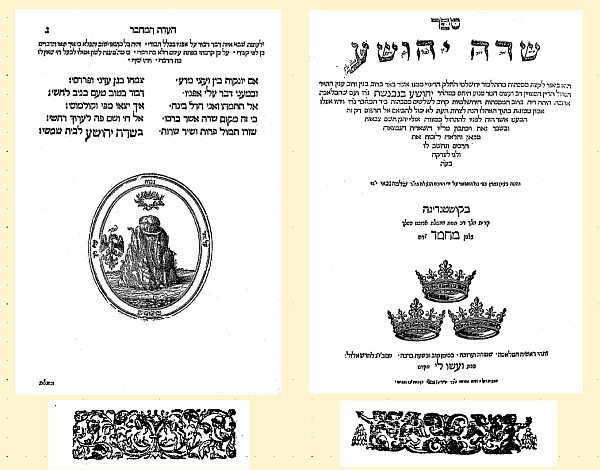
1662, Sedeh Yehoshu’a
Courtesy of the Klau Library, Hebrew Union College
This is the first part of Sedeh Yehoshu’a. Part Two was printed in Constantinople, 1749 (see below). The title page states that it is:
“on that portion [of the Jerusalem Talmud] which deals with the laws explained both as for the subject matter and its development and, since the work was lengthy, as he wrote on the majority of the tractates of the Jerusalem [Talmud], with almost thirty tractates in the possession of the author. . . . However, due to the troubles at this time it was possible to bring to press only these few [tractates] . . .”
As stated on the title page, the editor was R. Solomon ben David Gabbai. It informs that the beginning of work was on Monday, 13 Elul “And let them make me ועשו לי (422 = August 28, 1662) a sanctuary” (Exodus 25:8). The title page is followed by three pages of Benveniste’s introduction, with an ornamental border at the bottom of the second page, unusual for a work printed in Constantinople, in that it includes a number of human figures, which reappears at the end of Berakhot with other ornamental tail-pieces (see Figure 3). The device at the bottom of the following page is another floral frame; on the third page it is the image of the mount (hill). Benveniste’s introduction is followed by the approbation of R. Yom Tov ibn Ya’ish, which concludes with a tail-piece that includes two dogs, followed by the text.
In his introduction, Benveniste writes “I saw pearls of the Talmud laying in the corner and no one gathers them to explain it, to reveal its secrets and the wisdom of its words. I arose and relied upon the rock, blessed be He, examined holy books and decided to explicate and explain the halakhic portions of the Jerusalem Talmud. The aggadot of the Yerushlami are not addressed as they were already explained by R. Samuel Jaffe Ashkenazi in his Yeffe Mareh.”11 Mordechai, Margalioth informs that Benveniste made considerable use of Yeffe Mareh in Sedeh Yehoshu’a.12
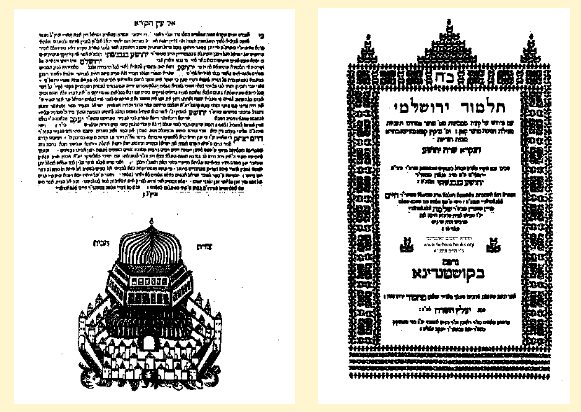
1662,
Sedeh Yehoshu'a 1749,
Sedeh Yehoshu’a
Courtesy of the Klau Library Courtesy of Hebrewbooks.org
Sedeh Yehoshu’a surrounds the Talmudic text. Initial words of tractates are set in small attractive frames. As with other editions of the Talmud, the text is in square letters; the lengthy commentary, Sedeh Yehoshu’a is in rabbinic letters. Brief verses from the author are on the final page of each tractate, and at the end errata, and a brief statement from Benveniste. In preparing Sedeh Yehoshu’a, Benveniste had access to the commentary, in manuscript form, on three tractates by R. Solomon Sirillo (d. c. 1553-55). Benveniste’s extensive knowledge of the Babylonian Talmud and on earlier commentators and codifiers, especially from the Spanish school, enabled him to establish the correct reading of the Jerusalem Talmud; thus explaining differences between his text and that of the Venice edition. He concentrates on the halakhic text, omitting aggadic subject matter.13 His method was to initially explain difficult words according to the Babylonian Talmud and the Arukh, and other works, explain a passage and compare it with a parallel passage in the Babylonian Talmud or according to the context if no parallel exists.14
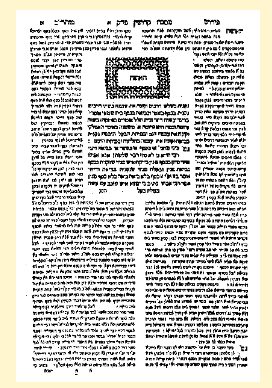
Sedeh Yehoshu’a
Courtesy of the Klau Library
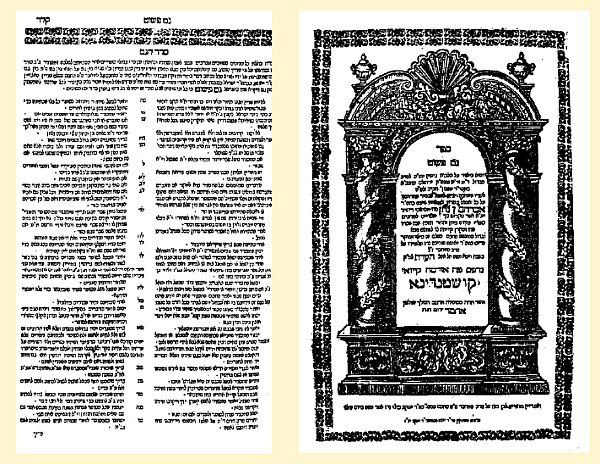
The next edition of Sedeh Yehoshu’a was published in Constantinople at the press of Reuben and Nissim Ashkenazi in folio format (20: [1], 66, 71, [3], 101 ff.) in the year 1749, “[Let the sea and all within it] thunder, the fields לפ"ג יעלץ השדה [and everything in them exult] ([5] 509 = 1749)” (I Chronicles 16:32).15 It is on an additional thirteen tractates: Pesahim, Ta’anit, Megillah, Hagigah, Mo’ed Katan, Ketubbot, Kiddushin, Gittin, Bava Kamma, Bava Batra, Makkot, and Horayot. The title page is followed by Benveniste’s introduction and the Ashkenazi pressmark of an image of the Temple.16 The volume follows the format of the previous edition, described above, that is, the text is in square letters, and the lengthy commentary, Sedeh Yehoshu’a, is in rabbinic letters. Heshey Zelcer describes Sedeh Yehoshu’a as prolix, suggesting that is why Benveniste’s commentary “did not become widespread among the scholars of Europe.”17 That Sedeh Yehoshu’a is lengthy, perchance prolix, is evident from the above image of a page from Kiddushin.
These are the only independent editions of Sedeh Yehoshu’a.18 However, Sedeh Yehoshu’a has frequently been reprinted together with the text as part of other editions.
Oznei Yehoshu’a - Sixty-seven discourses by Joshua Raphael Benveniste. Oznei Yehoshu’a was printed in folio format (20: 116 ff.) in the year 1677, “and let your face shine; and we shall be saved ונושעה (437 = 1677)” (Psalms 80:4, 9, 20) at the press of Abraham Franco. That press was originally founded by Solomon ben David Franco, from Andalusia, among the conversos from Spain via Portugal. He was an experienced printer but already elderly when he arrived in Constantinople in 1639 and founded his press.19
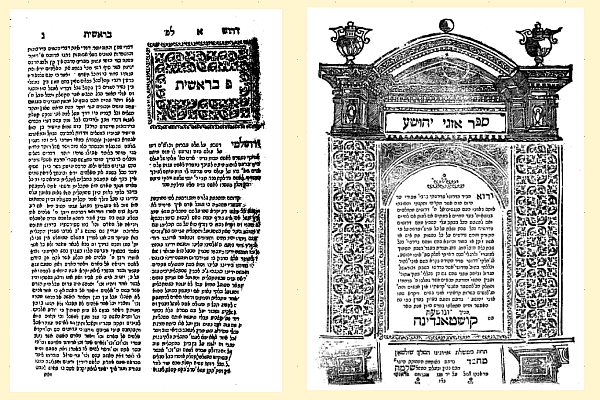
1677, Oznei Yehoshu’a
Joshua Raphael ben Israel Benveniste, Constantinople
Courtesy of the Library of Agudas Chassidei Chabad Ohel Yosef Yitzhak
Franco printed one title only, Rashi’s Torah commentary (1639), before his death. After a brief delay, publishing resumed in 1641 under the management of his son, Abraham, and his son-in-law, Jacob Gabbai. From 1648, only Abraham Franco’s name appears on the title page. Jacob Gabbai was either no longer a partner or deceased. Franco ceased printing in 1656, and resumed publishing in 1665. Among the works issued in the following years are two Shabbatean tikkunim. After another brief interval Franco published, at intervals, his last work, Zehav Seivah on Talmudic Aggadot by R. (Nissim) Solomon ben Abraham Algazi. Yaari dates this work to 1678 but there is now good reason to believe that the date of publication was 1688, extending the period of Franco’s activity by more than a decade.20
The title page of Oznei Yehoshu’a states that it is discourses delivered publicly to “‘the ears (oznei) of the people’ (var. cit.) ‘who come near the Lord’” (Exodus 19:22), discourses on “‘the living among the dead’ (Isaiah 8:19), ‘whether in death or life’” (II Samuel 15:21). It describes Oznei Yehoshu’a as being in three parts: discourses on the Torah, which Benveniste calls Oznei la-Torah and includes the discourses delivered on festivals and the miracles and kindness of the Lord; Ozen Anashim, eulogies for men; and Oznei Nashim, eulogies for women.
There are introductions from Benveniste; the editor, R. Solomon Gabbai, who informs of Benveniste’s expenditures to see the book printed; and from the printer Abraham Franco, who writes that his heart is as the “‘heart of a woman in her pangs’ (Jeremiah 41:42, 49:22) ‘and the anguish as of her who brings forth her first child’” (Jeremiah 4:31) on the death of his dear son, Solomon, who has been called to the heavenly yeshivah. The text follows in two columns in rabbinic type, concluding with a detailed index (summary) of the discourses.21 The discourses in Oznei Yehoshu’a are primarily on the Torah and festivals, with fourteen eulogies. Examples of the richness of the discourses and the nature of the index are:
Discourse 4 Parashah Va-Yera: It is explained that the Jewish people are compared to the body in all its parts. It continues with an explanation of the verses “But you cleave to the Lord your God” (Deuteronomy 4:4) in Parashah Va-Ethannan, for “For from the top of the rocks I see it” (Numbers 23:9) in Parashah Balak, and the verses of the parashah concerning Sodom, “Will you also destroy” (Genesis 18:23) and all that follows, and mention is made of the verses in Kings. . . .
Discourse 25 Parashah Shemini: It is explained that there is an obligation on every Jew to feel the pain of a talmid hakham and continues with an explanation of Rashi “your brothers,” (Leviticus 10:6). From here it is necessary to feel the pain of a talmid hakham, and the verses on Elijah concerning the [woman of] Zarephath. And it came to pass “that the son of the woman, the mistress of the house, fell sick” (I Kings 17:17) and it continues with the saying of the sages in the Pesikta “and Nadab and Abihu died before the Lord” (Numbers 3:4) . . . .
Avodah Tammah – on the liturgy for Yom Kippur, an exposition of Yom Kippur and a clarification of the variant readings for that day. The title page states that it includes the order of the service for the Day of Atonement (liturgy) and that it was published at the press of the late Abraham Franco in Constantinople, noted above, in c. 1695. The date is not given on the title page. However, at the bottom of the title page the rule of Sultan Ahmed is acknowledged. Ahmed II reigned over the Ottoman Empire from 1691 to 1695, which indicates the period of publication.
The title page begins that it includes the order of the service for Yom Kippur, the customary text followed everywhere for Yom Kippur. The text is based on manuscripts from many rabbis. It is accompanied by an explanation of the subject matter and terminology according to the Talmud and halachic authorities, prepared and edited by Joshua Raphael Benveniste. At the end are prayers to be said on Rosh Hashanah, Yom Kippur, and Kol Nidre from the Ari ha-Kodesh (R. Isaac Luria, Arizal, 1534-72).22
c. 1695, Avodah Tammah
Courtesy of the National Library of Israel
Seder ha-Get; Mitzvat Halizah – Two additional small works by Joshua Raphael Benveniste are Seder ha-Geṭ, on the formula for divorce, written in Bursa in 1642, and Mitzvat Halizah on the laws of relating to halizah, that is the biblical obligation of the brother of a deceased man to marry his widow when there were no offspring from the couple. Both were published at Constantinople, 1719, as an appendix to R. Moses ibn Habib’s (1654-1696) Get Pashut in the year “Moses came to the Tent of the Testimony ויבא משה אל אהל העדת (479 = 1719)” (Numbers 17:23). Get Pashut was published in folio format (20: 143 ff.). Seder ha-Geṭ (ff. 134a-140b) is followed by Mitzvat Halitzah (141a-143b).
1719, Seder ha-Get 1719, Get Pashut
Courtesy of Otzar HaChochma Courtesy of
Hebrewboooks.org
The text of the title page begins that it is an explanation of the laws of gittin (divorce) in the [Shulchan Aruk] by R. Moses ibn Habib. It is followed by a brief approbation signed by four rabbis, R. Abraham Kimhi, R. Samuel ha-Levi, R. Hayyim Kimhi, and R. Judah Rosenes, followed by the text in square letters, beginning with Hilkhot Gittin no. 119. The text is in square letters, the accompanying extensive commentary is in rabbinic letters. As noted above, Benveniste’s works are at the end of the volume.
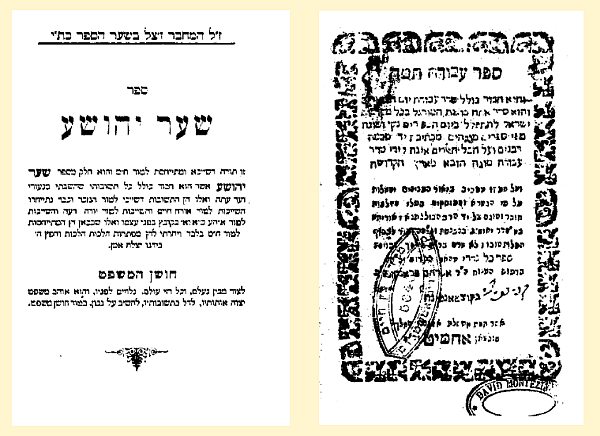
Sha’ar Yehoshu’a – Our final work by Joshua Raphael Benveniste is a collection of responsa published in 1904 in Husiatin in the western Ukraine (eastern Galicia) on the banks of the Zbruch River, in octavo format (80: [1], 116 ff.), press unknown. According to R. Ḥayyim Joseph David Azulai (Chida, 1724-1807), Sha’ar Yehoshu’a was originally written on the Arba’ah Turim, but most of the work was lost in a fire. However, several of Benveniste’s responsa are included in the responsa of R. Moses Benveniste (Penei Moshe) and of R. Joseph Trani (She’elot u-Teshuvot).23 In addition, ninety-seven responsa on Ḥoshen Mishpat that were in manuscript were published in this Husiatin edition.
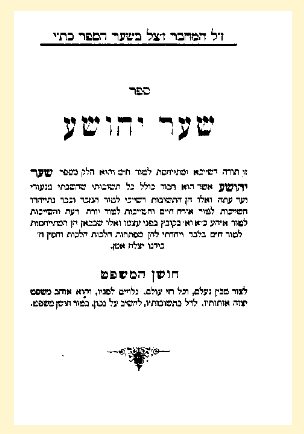
1904, Sha’ar Yehoshu’a
Courtesy of
Hebrewboooks.org
The volume has two title pages; the first is basic, simply stating that the author is Joshua Raphael Benveniste from Constantinople, author of Sedeh Yehoshu’a on the Jerusalem Talmud, and a student of R. Joseph Trani, author of the She'elot u-Teshuvot Maharit. It informs that it is printed for the first time from a manuscript of the author sent by R. Abraham Palacci av bet din Izmir for publication by the Dovav Siftei Yesheinim society in Husiatin.24
The more detailed second title page notes that the responsa are on the Tur [Hoshen Mishpat]. At the end of the volume is an index of the responsa. The text begins that it is on Hoshen Mishpat, that is, the fourth part of the Arba’ah Turim dealing with judicial procedure, monetary affairs, property issues and personal injuries, etc. The responsa are generally lengthy. An index has been attached to this work. The following are examples of the responsa subject matter from the index.
21 – Reuven died and left young sons. Shimon, his father-in-law, was made their guardian and sold a property to Levi who took possession according to halacha. After a period of time Levi passed away, leaving a small son. Afterwards Shimon passed away. Reuven’s orphans protested the sale saying that Shimon, their grandfather, was not a guardian, not from their father nor from the Bet Din. They wanted to take the property from Levi’s son.
26 - Reuben raised an orphan girl in his house. He married her to Shimon and gave them a dwelling and did not specify if it was rented or free. Seventeen years passed and Reuben required payment for the residence. After three years, he said to Shimon you know that I didn’t give the residence except as a rental, which Shimon denied, you didn’t tell me anything and there are no witnesses to it.
27 – One who aspires to be a noble (Nasi) and have a position with the minister, and another came and achieved the position and then compromises with him.
In this article we have discussed Joshua Raphael Benveniste’s works, beginning with Sedeh Yehoshu’a on the Jerusalem Talmud, followed by Oznei Yehoshu’a sixty-seven discourses, Avodah Tammah on the liturgy for Yom Kippur, Seder ha-Get; Mitzvat Halizah two small works on the formula for divorce and, on the laws relating to halizah, and concluding with Sha’ar Yehoshu’a,, a collection of responsa. A collection of varied works by a scholar of achievement.
In addition to the above titles, Joshua Benveniste authored several other works, still extant in manuscript. Among them are Mishmeret ha-Mitzvot, a versified enumeration of the mitzvot as enumerated by Maimonides, and Levush Malkhut, a versified hymn in praise of the Creator, in the style of R. Solomon ibn Gabirol’s Keter Malkhut, based on medical science and printed at the end of Asefat Zekanim (Jerusalem, 1976), Shir (Montefiore Ms. 377), on prosody and meter; and a discourse on medicine.25
As noted in the title, the Benvenistes were a distinguished family of eminent, prolific, and scholarly authors. The title of this article notes two Benveniste brothers, that is, Joshua Raphael and Hayyim ben Israel Benveniste, but in its text addresses one brother only, Joshua Raphael. The reason is twofold. First, it might be burdensome for the reader to have to read the numerous details of the works of both brothers in one article. Secondly, although we address Joshua Raphael’s writings here, Hayyim Benveniste was also a scholar and a most interesting person. His works, certainly of significance, are deserving of an independent article. Hopefully, in the not too distant future, we will provide an article on Hayyim ben Israel Benveniste, completing the content promised in the title.
1 Once again, the author would like to express his gratitude and appreciation to Eli Genauer for reading this article and his helpful corrective annotations. Marvin J. Heller is an award winning author of books and articles on early Hebrew printing and bibliography. Among his books are the Printing the Talmud series, The Sixteenth and Seventeenth Century Hebrew Book(s): An Abridged Thesaurus, and several collections of articles.
2 Richard Gottheil, Meyer Kayserling, Isaac Broydé, “Benveniste” Jewish Encyclopedia. vol. 3 (New York, 1901-06), pp. 38-41.
3 “Benveniste (also Bienveniste, Benvist, Abenbenist, etc.),” Encyclopedia Judaica, (Jerusalem, 2007), vol. 3 p. 382.
4 Yeshayahu Vinograd, Thesaurus of the Hebrew Book. Listing of Books Printed in Hebrew Letters Since the Beginning of Printing circa 1469 through 1863 I (Jerusalem, 1993-95), p. 206 [Hebrew].
5 Mordechai, Margalioth, ed., Encyclopedia of Great Men in Israel III (Tel Aviv, 1986), cols. 770-72 [Hebrew].
6 This article is on Joshua Raphael ben Israel Benveniste. Hayyim Benveniste is addressed in a separate article, in Sephardic Horizons, Vol.16, Issue 1-2.
7 Heshey Zelcer, A Guide to the Jerusalem Talmud (2002), p. 147.
8 Hersh Goldwurm, The Early Acharonim: Biographical Sketches of the Prominent Early Rabbinic Sages and Leaders from the Fifteenth-Seventeenth Centuries (Brooklyn, 1989), pp. 177-78; Gottheil, JE, op. cit.; Encyclopedia Judaica, op. cit.; Shimon Vanunu, Encyclopedia Arzei ha-Levanon. Encyclopedia le-Toldot Geonei ve-Ḥakhmei Yahadut Sefarad ve-ha-Mizraḥ II (Jerusalem, 2006), pp. 840-46 [Hebrew].
9 Avraham Yaari, Hebrew Printing at Constantinople (Jerusalem, 1967), pp. 37-38, [Hebrew].
10 Yaari, Printers’ Marks, nos. 18, 36 pp. 12, 23, 130, 137.
11 R. Samuel ben Isaac Jaffe Ashkenazi (1525–1595) was rabbi of the Ashkenazi community of Constantinople. Among his works is Yeffe Mareh (Constantinople, 1587; Venice 1590) on the aggadot in the Jerusalem Talmud. Shabbetai Bass (1641-1718), author of Siftei Yeshenim (Amsterdam, 1680), the first bibliography of Hebrew books by a Jewish author, describes Sedeh Yehoshu’a (p. 75 no. 88) as a commentary on all the aggadot in the Jerusalem Talmud, but on Seder Zeraim (Constantinople) only, Siftei Yeshenim having been written before publication of the second volume of Sedeh Yehoshu’a. Bass also notes Benveniste’s Oznei Yehoshu’a, correctly describing it as being comprised of sixty-seven discourses.
12 Margalioth, op. cit. vol. III col. 701.
13 Louis Ginzberg, A Commentary on the Palestinian Talmud. A Study of the Halakah and Haggadah in Palestine and Babylonia I (New York, 1941), liii-liv; Shimon Vanunu, Encyclopedia le-Hakhme Turkiyah: Toldot Hayehem vi-Yetsirotehem shel Rabbanei Turkiyah (Jerusalem, 2006), pp. 295 -301 [Hebrew]; Yaari, Constantinople, pp. 154-55 no. 257a; idem, Printers' Marks, no. 36 pp. 23 and 137.
14 EJ, op. cit. vol. 3 p. 384.
15 Hebrew title pages often include the letters לפ"ק, or less frequently לפ"ג, after a date, to distinguish between the abbreviated and full era. Dates given in the abbreviated form לפ"ק)) do not use the first digit to represent thousands (millennium). Conversely, the full form (לפ"ג) utilizes the first digit to represent thousands. In computing a Hebrew date, it is important to know whether a date is for the full or abbreviated era, to determine whether a five is to be counted as five thousand or is to be included in the calculation of the date other than as thousands. The current millennium began in 1240, so that all subsequent secular dates are derived by adding that number to the Hebrew date, for example, 509 plus 1240 equals 1749. The result is only approximate, however, as the Hebrew year begins three to four months earlier than the secular year.
16 Yaari, Constantinople, pp. 154-55 no. 257a; idem, Printers' Marks, no. 124 pp. 78 and 165.
17 Zelcer, op. cit.
18 Ch. B. Friedberg, Bet Eked Sepharim, (Israel, n. d), shin 474 [Hebrew].
19 Avraham Yaari, Hebrew Printing at Constantinople (Jerusalem, 1967), p. 34 [Hebrew].
20 Friedberg, History of Hebrew Typography in Italy, Spain-Portugal and the Turkey, pp. 125-27 [Hebrew]; Yaari, Constantinople, pp. 34-35.
21 Shimon Vanunu, Encyclopedia Arzei ha-Levanon. Encyclopedia le-Toldot Geonei ve-Hakhmei Yahadut Sefarad ve-ha-Mizrah, II, pp. 844-47 [Hebrew]; Yaari, Constantinople, pp. 157 no. 265.
22 Yaari, Constantinople, pp. 158-59, no. 269.
23 Ḥayyim Joseph David Azulai, Shem ha-Gedolim reprint (Livorno, 1774, Jerusalem, 1979) vol. 2 p. 37 no. 71 [Hebrew].
24 R. Abraham Palacci (1809-99) was chief rabbi of Izmir (Smyrna) for thirty years. He was the author of sixteen works in Hebrew and one in Ladino. (JE, vol. 9, p. 467).
25 EJ , vol. 3 p. 384.
Copyright by Sephardic Horizons, all rights reserved. ISSN Number 2158-1800