
Anthony McElligott
THE LAST TRANSPORT
The Holocaust in the Eastern Aegean
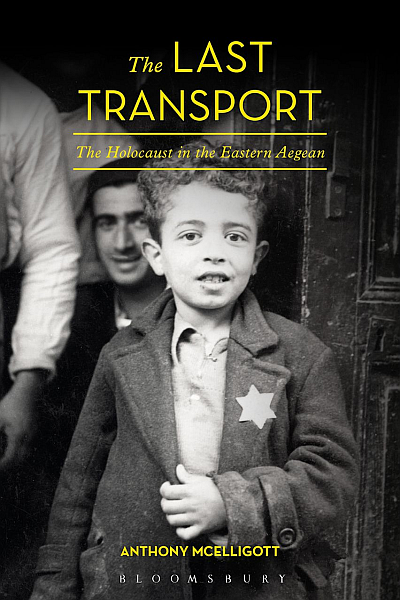
Bloomsbury, 2024, ISBN-13: 978-1474227995
Reviewed by Paul Isaac Hagouel1
This opus by Professor McElligott fills in lacunae in Italian, Greek, and Holocaust History and Historiography pertaining to the annihilation of the Jewish (Italian) inhabitants of the island of Rhodes and, of the neighboring island of Kos situated in the southeastern edge of the Aegean Sea.
It is interesting to point out from the beginning that the book comprises twenty-two pages before the main text including contents, maps, etc., 351 pages of text, and 193(!) pages of notes from primary sources, secondary and bibliographic sources, and an index. As the author states, his main approach to the topic is microhistory. As such, the book, sometimes, becomes a compendium of details. However, the historical narrative is brought to life with vivid depictions something that, usually, we don't come across in historiography that takes the macrohistorical path.
The first chapter is titled The Holocaust in its Aegean Context. Unfortunately, it fails to deliver and does not provide the full frame and context in which the cause of the deportation of the Jews of Rhodes and Kos should “fit.” The reader finds Greece to be occupied by the Germans in 1941, with no background story to explain. There is no mention whatsoever how that came to be. There is no mention of the declaration of war by Italy against Greece on the 28th of October 1940. No mention of the Greeks pushing back and beating the Italians in the Albanian front. And no mention of the Germans invading Greece to assist Italy on 6 April 1941, and the subsequent occupation. And, finally, the division of occupied Greece in Italian (till September 1943), Bulgarian, and German zones.
Thus, the fate to the Jews of the Eastern Aegean is inexorably linked to, both, them being Italian and the proximity of the Germans who occupied all of Greece and its islands after September 1943. In my humble opinion, none of these facts are emphasized.
And there are some factual errors: On page three, we read that Jews were about ten percent of the Greek population. The correct number is 1% (one percent). On page seven, it is stated that the Jewish population of Greece stood at 77,380 and that of Thrace at 5,100. At that time, Thrace was and is still part of Greece and its number is included in the total Greek population. The reader might be confused. Also, Macedonia is a Greek province and what is stated as Macedonia on the eve of the war was Southern Serbia of Yugoslavia.
All the subsequent chapters show and prove the breadth of the research done by Prof. McElligott.
The title of the book does not do justice to the affluence of details of the everyday life of the Jews in Rhodes right up to the deportations that the narrative unfolds for the reader in Chapters 2. Inside the Juderia, 3. Italian and Jews, and 4. The Germans on Rhodes.
A spoiler is due at this point: most of the Italian military in Rhodes, after the capitulation of Italy in September 1943, professed allegiance to the Italian Socialist Republic. This was the last incarnation of a fascist state under Mussolini and a full ally of the German Reich. They declared Jews to be enemies of the State. Thus, the fate of the Jews of Eastern Aegean was sealed. This is another proof that debunks the myth of the “Italiani Brava Gente.”
The next two, Chapters, 5. Deportation and 6. Auschwitz and Other Camps, bring to life the ordeal of the deportation “journey” to Auschwitz, as well as the daily uphill struggle with effort and determination by the inmates, chosen for forced labor, to avoid death or, at the best, to try to cheat it.
The seventh chapter, The Spoils of Deportation, touches on a very sensitive subject, that of restitution. This is also part of the Holocaust. The annihilation of the persons is just the peak. On page 214 McElligott states that
“Research into the sequestration of Jewish-owned property in Greece or the Aegean islands during the occupation and after the deportations of its owners, and its transfer to non-Jewish ownership, is still in its infancy.”
No, some research has already appeared, however the full extent of the sequestration and/or outright looting will be never known.
Finally, and using historian Aly Götz,2 a mundane reason for the genocide of the Jews, if such a description as mundane stands scrutiny, was just pure theft alongside, of course, with the racist genocidal delusions of Adolf Hitler. Therefore, the Jews of Rhodes and Kos were deported and exterminated, pure and simple, within the framework of the Final Solution of the Jewish Problem.
Chapter 8. Return to Life also relates to the Holocaust and extremely painful. The “return” “played” out for the Rodeslis the same as for their coreligionists in other devastated communities, e.g. Thessaloniki.
The book wouldn’t conclude better than its final Chapter 9. A ‘Lost World’ Remembered and Remade. Despite the calamity, survivors and their offspring are, both, rebuilding and remembering their particular heritage. This is ongoing and intergenerational. And this book contributes a lot to that end.
I fully recommend this book for either the lay person and, equally, for the experienced researcher of the Holocaust.
1 Paul Hagouel was born in Athens in 1950, lives in Thessaloniki, Greece. He is a Holocaust researcher since 1995; member of the Greek Delegation to IHRA since 2013; member of the Committee on the Genocide of the Roma (IHRA) since 2015, its Chair in 2022; Retired Electrical Engineer, Ph.D. in EECS, University of California, Berkeley, 1976.
2 Aly Götz, Hitler's Beneficiaries: Plunder, Racial War, and the Nazi Welfare State, (Picador, imprint of Macmillan Publishing, 2008).