
My Ioannina Odyssey
A film directed by Gary Glassman
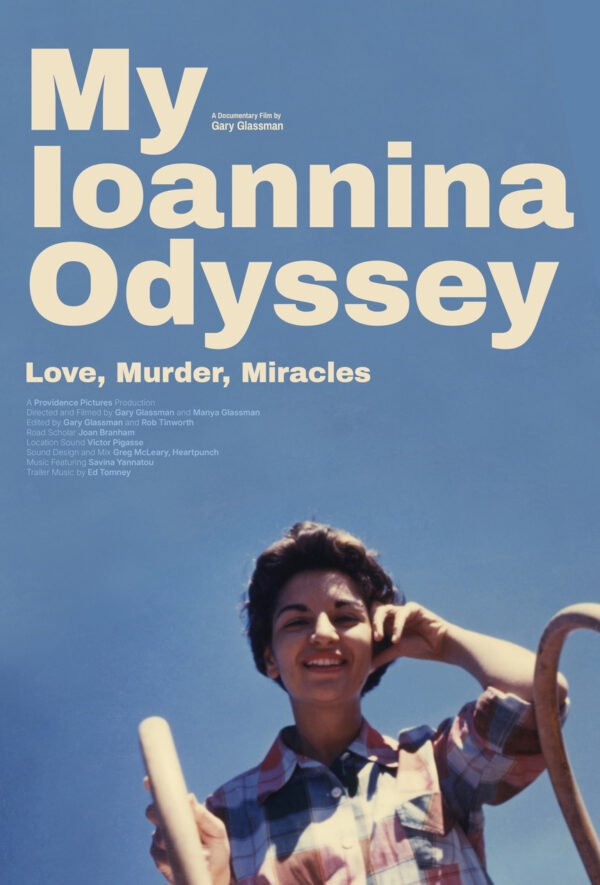
Reviewed by Annette B. Fromm1
Many years ago, I spent a year in Ioannina, Greece, conducting research in the Jewish community for a doctoral dissertation in folklore. My interest as a folklorist was to observe and document how ethnic identity was preserved in the remains of traditional cultural practices in a greatly reduced urban population. At the end of the year, I concluded that numerous individuals with ties to the community made return visits; I framed them as pilgrims enacting secular pilgrimages to revitalize a fictive community they had learned of from their parents and grandparents.2
Gary Glassman, the American director of My Ioannina Odyssey, made such a pilgrimage and joined the long line of pilgrims to this city on the lake. Glassman’s maternal grandfather left Ioannina to join cousins in New York in the early decades of the twentieth century, along with about one thousand other Ioannina Jews. Early in the film, Glassman tells viewers that his earliest memories were that he was Greek, a Greek Jew, a Jew whose mother’s family came from Ioannina. Incidently, my maternal grandparents were also immigrants from Ioannina who met and married in New York City at about the same time as Glassman’s grandfather came to the U.S. I, too, grew up with the distinct knowledge that I was a Greek Jew, like Glassman only one half Greek.
This relatively short film, under thirty-five minutes, skillfully weaves together history, family stories, and discoveries, as the director seeks answers to a box filled with documents and photos of “lives long gone.” The film is beautifully illustrated with historic and present-day images. A sound track of Greek music and songs including Greek Jewish songs collected from Mrs. Anna Raphael in 1960 accompanies the film. Glassman relates the ancient origin story/myth of the community: a shipload of Jewish slaves being transported to Rome swept off course by a storm found their way to the city by the lake. He also reviews the more recent tragic events on March 25, 1944, when community members were loaded onto trucks for the deportation to Auschwitz. There, nearly 90% of the Jews of Ioannina were murdered.
Glassman also traces the few family members who remained in Ioannina or returned after World War II. His great uncle, his grandfather’s brother, upon his return married the sister of his first wife who did not survive. Glassman finds and visits their home, now a restaurant on a main street through the city’s kastro (walled city). He meets a distant cousin who was named for the great uncle. Additional photos in his collection document members of this family.
The film starts with a quote from Homer’s Odyssey directing the telling of the story of the wanderer. Glassman associates the themes found in Homer’s Odyssey—prophecy, destiny, and miracles—with his personal odyssey to Ioannina and his family’s heritage. For example, his grandmother in New York remained childless. A fortuneteller directed his grandfather to return to the city of his birth, which he did in 1929. His mother was born sometime afterward.
Glassman closes the film, a highly personal odyssey, with a traditional Hebrew prayer, zichrono livricha, “May his memory be a blessing.” Through these simple and straightforward words, he places importance on the wealth of family documents, the varied pieces of his upbringing, and his trip to Ioannina with his daughter and his wife to validate those memories and to create an extended family. Like Homer’s Odyssey he has come home.
My Ioannina Odyssey is significant because it is yet another, albeit intensely personal, piece in the puzzle of the extended story of the Jewish community of Ioannina, Greece. With a disparate collection of photos, a few objects, and some memories, Glassman recreates the lives of family members in a community long gone.
My Ioannina Odyssey took home an honorable mention and the Orpheus Audience Award at the 2026 Los Angeles Greek Film Festival (LAGFF) inaugural LAGFF-doc in February 2026.
1 Annette B. Fromm is the review editor and associate editor of Sephardic Horizons. She is a descendant of a Greek Jewish family on her mother’s side.
2 We Are Few: Folklore and Ethnic Identity of the Jewish Community of Ioannina, Greece (Lanham: Lexington Books, 2008).