
Jacob Daniels
THE JEWS OF EDIRNE
The End of Ottoman Europe and the Arrival of Borders
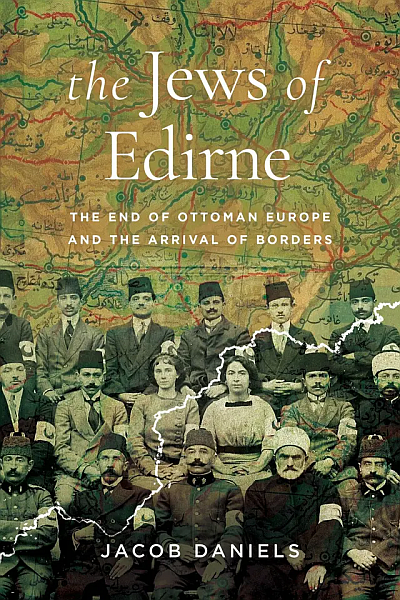
Stanford University Press, 2025, ISBN: 9781503641983
Reviewed by Anthony Gad Bigio1
Jacob Daniels, Assistant Professor of Instruction and Assistant Director of the Schusterman Center for Jewish Studies at the University of Texas at Austin, has published a remarkable book about the history of Edirne’s Jewish community. Through a deeply researched and very informative volume, he illustrates how it “survive[d] the horrors of the last Ottoman decade only to unravel during the relatively peaceful years of the early Turkish Republic” (p. 3).
Daniels suggests that historians of Jewish communities of the late Ottoman Empire “might turn their attention from colorful port cities and Francophone intellectuals towards overland Sephardi networks, physical mobility between (and within) states, and the fate of both in the late nineteenth and early twentieth centuries” (p. 181). This he has brilliantly achieved in the case of Edirne, the capital of Thrace province, and all of the vast Ottoman European expanses of yesteryear that is left in modern Turkey.
Through his work we learn about that critical quarter-century, bookended by the Young Turk Revolution of 1908 and the “Thrace Events” of 1934, when that long-standing Jewish community was inflicted a very hard blow that precipitated its demise; in fact, the only episode of overtly anti-Jewish violence occurring in Kemalist Turkey. It was a tumultuous period during which Edirne repeatedly changed hands with neighboring Bulgaria and Greece. Turkey finally gave up three quarters of the province, and population exchanges reconfigured its ethic composition.
The borderland nature of Edirne is a key feature of Daniels’ research. He sources inspiration and methods from “borderland studies,” which are mostly concerned with the territorial fragmentation in Central Europe and the “shatterzone of empires,” as defined by Omer Bartov and Eric D. Weits.2 Daniels “encourages scholars to compare and connect the experience of Jews across borderlands” (p. 13), presenting Thrace as another territory where local Jews were confronted with emerging borders that impacted their cultural and commercial networks, nation-states replacing empires, and varying requests of allegiance, and of the use of foreign languages.
Edirne was the Ottoman’s capital well before their conquest of Constantinople. For centuries it remained a city of primary importance. Sultan Selim II had the empire’s largest mosque erected here in 1575. Successful campaigns of European territorial conquest were conducted all the way to vicinity of Budapest and Vienna. The Sarayiçi, the 15th century fortified imperial palace, remains a testimony of Ottoman military expansion for the ages.
Its local Jewish community was founded by Romaniote Jews, but was later greatly boosted by the arrival of Sephardi refugees from Spain and Portugal who built the city’s original thirteen synagogues, each reflecting the disparate origins of their worshippers. As smaller Jewish communities settled in Thrace’s secondary centers, Ottoman authorities eventually allowed for a chief rabbinate to encompass the entire province. Thrace’s economy revolved around the production of silk, stock-breeding of sheep and goats, and the operation of the railroad network that connected it regionally.
With the support of local maskilim or Haskalah followers, the Alliance Israélite Universelle opened its first school in Edirne in 1867, followed by many others across the province. The Ladino-speaking Jews of Thrace were introduced, as were their brethren in other parts of the empire, to French language and culture and to an ethos of greater productivity. This was considered essential to counter the poverty of parts of the community as well as to compete with other, more successful minorities including Armenians, Greeks, and Bulgarian Christians.
Traditionally, Jews were mostly active in simple jobs and occupations in commerce and the service industry, while a destitute segment of the community relied on charity to survive. The network of Alliance schools, through its teachers and administrators, provided linkages with Istanbul as well as with Paris, the organization’s headquarters. Its programs eventually allowed for the emergence of a new class of Jewish professionals: “lawyers, doctors, state functionaries, employees of the railway company, and agents of European financial institutions” (p. 41).
The Young Turk Revolution of 1908, when army officers from Salonika forced the Sultan to reinstate the Constitution suspended for thirty years, marks the beginning of Daniels’ storyline. The new Comité Union et Progrès government launched the season of “Ottomanism,” promising equal rights to all citizens, providing their commitment to the empire and belief in its political institutions. In Edirne, as in other Turkish cities, a wind of hope and change swept all communities, including the Jewish one, seeking opportunities for freedom and renewal.
Ottomanism challenged the Jewish use of Ladino and French and promoted the adoption of Turkish as the common language. The Zionist Organization, which established a branch in Istanbul after 1908, however, promoted different views via its own newspapers. Soon tensions emerged in Edirne between Alliance schools and Zionist clubs, each supporting more or less assimilation and adherence to the empire. The Edirne Ladino press jumped into the fray, sparring with the rabbinate, the Alliance, and the Turkish press.
Meanwhile Bulgaria, formerly an Ottoman province, declared its independence, hardening the border between the two countries and compromising the fluidity of Sephardi regional networks. The two Balkan Wars ensued in 1912 and 1913, Muslims and Jews fled towards Istanbul as Edirne was occupied by the Bulgarian army putting an end to the former convivencia between communities. When the city was reconquered by the Ottomans, an outflow of Christian populations took place in what was becoming a more unstable and insecure “borderland.”
World War I tore Thrace and its Jewish community, which lost over half of its members to migration to “Istanbul, Paris, the Americas and elsewhere” (p. 109), further apart. Young Jewish men were either escaping the draft or being enlisted in the Ottoman army. Tensions were mounting, this time with the Greek Christians inhabitants of Thrace who were being forcibly expelled, while Muslim refugees from Macedonia were flowing into the province. Bulgaria’s alliance with Turkey during the war meanwhile facilitated the resumption of Sephardi cross-border activities.
As if such previous upheavals weren’t sufficient, Greece occupied Thrace during the post-war period as the Ottoman Empire was crumbling. Jewish community leaders and institutions learned to make do and get along with the new Greek rulers over the next two years, only to be blamed for collaborationism with the enemy once Edirne and about a quarter of the original Ottoman Thrace province became firmly part of the Turkish Republic in 1923.
By the early thirties, the situation in Edirne was tense again, with a military build-up on both sides of the Bulgarian border. Jewish merchants had taken over the commercial networks of Thrace that had once belonged to Bulgarian and Greek Christians, the latter expelled in a population exchange with Muslim refugees from Greece. The Kemalist attempts to build up a Turkish-Muslim economy were faltering and resentment against the Jewish minority was growing.
This was the context of the “Thrace Events” of July 3-5, 1934, during which Jewish shopkeepers and residents were attacked in Edirne and in secondary centers with some ugly episodes of physical violence and looting. Mass panic ensued and a chaotic exodus of the Jewish community towards Istanbul, with some also escaping across the borders to Bulgaria and Greece. The government quickly intervened to restore order, arresting and punishing local officials responsible for the events, but the new facts on the ground were irreversible. Thrace and Edirne were finally Judenfrei, which is what the Turkish authorities ultimately wanted.
Daniels’ narrative is very rich in local facts, anecdotes, and details. He introduces readers to a multitude of characters, from rabbis to educators, journalists and businessmen, but four stand out through the quarter-century covered in his book. Most prominent is Angèle Guéron, the director of the Alliance girls’ school of Edirne, assigned to Thrace right after the Young Turk Revolution. She was a pioneer in many ways who managed her role with gusto and commitment. She also kept a diary which provided very thoughtful insights during the Bulgarian occupation.
Moise and Rosa Mitrani, husband-and-wife Alliance educators and school directors shouldered great responsibilities for the well-being of the Jewish community of Thrace. He, in particular, as its president during those multiple change of hands of the province adapted the teaching of national languages as required, hired and fired teachers accordingly, and argued against the Zionists’ single-mindedness. His letters back to Paris headquarters were invaluable sources.
Perhaps the most colorful of the four is Josef Barishac, founder and director of La Boz de la Verdad, that quickly became the most prominent Ladino newspaper of the province. He published it for seventeen years with some temporary closures. His Alliance education and strong republican beliefs made Barishac challenge the rabbinate on-and-off as well as the perceived anti-Semitism of local Turkish publications in the name of defending local Jewish identity.
The book certainly accomplishes its stated intent of exploring in-depth Jewish borderland life in Thrace, as well as the Sephardi networks reaching across Bulgaria and Greece and their evolution, in the context of the demise of the Ottoman Empire and the establishment of nation-states. The microcosm of Thrace is however too limited a scope to interpret fully the profound transformations that Turkey underwent during the Kemalist years since the establishment of the Republic in 1923, and their impact on the destiny of its Jewish community.
Government policies formulated in Ankara were affecting the entirety of the national fabric. They were, of course, also changing the reality on the ground in Thrace. Republican Turkey, with its secular constitution, elected parliament, and president, and stated equal rights for all citizens, paradoxically turned out to be more intolerant of its religious minorities than the Ottoman Empire, an absolutist state dominated by the sultan, the spiritual leader of the Islamic umma.
A new ethno-nationalism took shape under Atatürk; it provided a new collective social identity, based on the myths of the glorious origins of the Turkish people who descended upon the Mediterranean coast from Central Asia. There was now a “sovereign element” in control of the nation as defined by Atatürk. The Turkish language, profoundly reformed by Mustafa Kemal in 1928, was expunged of its Arabic and Farsi influences and provided with a new alphabet. It was proclaimed the new national language.
The “Compatriot, speak Turkish!” campaign hit Jews very hard, as their knowledge of the language was so limited. The protective rights of minorities, Armenians, Greeks, and Jews, to maintain their own communal, educational, and religious institutions, to speak their own languages, to access public-sector jobs, all granted under the Lausanne Peace Agreement, were quickly jettisoned. Both Ladino and French were forbidden as languages of education in 1925, and the Alliance’s school system folded its operations in Turkey after sixty-five years.
In 1924, David Fresco, the publisher and editor of El Tiempo, Turkey’s most prominent Ladino newspaper, stated:
Judaism in this country is shocked to find itself in a horrible situation. While on one side they are singing hymns to the Republic, announcing to the whole world the reign of democracy, and that all Turks, sons of the homeland, with no difference of race or religion, are absolutely equal before the law, enjoying all the rights of citizens, Judaism is being abused and despised as if it carried the plague.3
Things only get worse for minorities in the decade leading up to the Thrace Events, as Greeks and Armenians, while de jure citizens, were considered “foreign” on account of their past armed upheavals during and after World War I. Their exodus from Turkey was actively encouraged. Ankara approved a law that reserved the vast majority of professions to Turkish-Muslim citizens, impacting the Istanbul Greek community, which left en masse. Armenians were forbidden from selling or bequeathing their assets, which were slated to become properties of the state, causing their further collective departure to Syria, then under the French Mandate.
The Kurdish minority, while Muslim, was actively repressed for its resistance to the secular and nationalistic policies of the Ankara government. A number of Kurdish rebellions occurred, each suppressed more violently than the previous one, with casualties in the tens of thousands. The Minister of Justice Mahmut Esat Bozkurt declared in 1930:
All friends, enemies and the mountains, shall know that the Turk is the master of this country. All those who are not pure Turks have only one right in the Turkish homeland: the right to be servants, the right to be slaves.4
Republican social engineering took the form of mandatory population displacements, replicating on a big scale the time-honored Ottoman practice of sürgün. The Resettlement Law, adopted in 1934, weeks before the Thrace Events, empowered the Minister of Interior to redistribute the country’s population according to its degree of adherence to “Turkish culture.” Thrace, as well as Kurdistan, fell into Zone 3: “Areas from which individuals should be evacuated for military, economic, political, or public health reasons, and where their resettlement is prohibited.”
From Istanbul, nationalistic and pro-Nazi newspapers incited the Muslim population of Thrace against its Jewish residents:
… Edirne’s glorious Fridays have become Saturdays … We are not told of heroic stories in the shades of the trees. In the shade of the trees, the sons of Moses are counting their daily profits. They are the most ignoble nation in the world.…5
The Thrace Inspectorate General, after establishing martial law in response to mounting hostilities with Bulgaria, issued a report assessing the loyalty of the provincial population, stating: “We have a Jewish problem […] their intentions are to turn Thrace into Palestine.”
Thrace’s borderland identity, exacerbated by national security tensions with Bulgaria, made it the flashpoint for the unofficial enactment of the Resettlement Law. As soon as violence erupted in Thrace, two prominent Jewish lawyers traveled from Istanbul to Ankara; on July 3rd they pleaded with Atatürk to make the government stop the on-going persecution of the Jews and to issue official and public reassurances. Atatürk agreed. On July 5th, Prime Minister İnonü stated that “anti-Semitism is not a government policy.” The Thrace Events proved him wrong.
1 Anthony Gad Bigio is the author of A Sephardi Turkish Patriot – Gad Franco in the Turmoil of the Ottoman Empire and the Turkish Republic (Bloomsbury, 2023), the historical biography of his maternal grandfather. An architect and urban planner, he has worked internationally including for two decades at the World Bank. Subsequently, a graduate professor of planning at George Washington University, he now pursues his personal writing projects.
2 Omer Bartov and Eric D. Weitz, eds. Shatterzone of Empires: Coexistence and Violence in the German, Habsburg, Russian, and Ottoman Borderlands. Bloomington: Indiana University Press, 2013:13.
3 “The language of Turkish Jews” in El Tiempo, Nov. 26, 1924.
4 Son Posta, Sept. 20, 1930.
5 Milli Inkilap, July 1, 1934.