
Ayelet Tsabari
SONGS FOR THE BROKENHEARTED
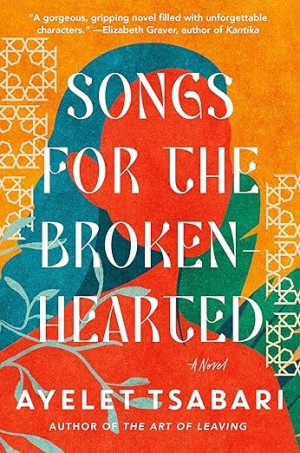
New York: Random House, 2024, ISBN-13: 978-0812989007
Reviewed by Oren Yirmiya1
Ayelet Tsabari's recent novel, Songs for the Brokenhearted, is exactly as the title promises, a heartbreaking book. Two narratives are interwoven; the first follows the hopeless love story of Yaqub and the already-married Saida in an Israeli immigration camp for Yemeni migrants in the early 1950s. The second is set in late 1995, during the months leading up to Rabin's assassination. Here, the now-elderly Saida has just died, and her youngest daughter, Zohara, an NYU Ph.D. candidate on leave, returns to Israel for the funeral, whereafter she discovers her mother's forbidden adolescent romance and her lifelong practice as a composer and writer in the tradition of Yemeni women's songs. She also confronts anew an absence that has shadowed her entire life: the disappearance of her older brother Refael, one of hundreds of Yemeni, Mizrahi, and Balkan children whose deaths were falsified, as medical and governmental authorities separated them from their families in the early years of Israeli statehood.2 Running alongside Zohara's story is a plotline centered on Yoni, her nephew and Saida's oldest grandson. Devastated by his grandmother's death, Yoni is drawn into extreme right-wing circles seeking to strike out against Rabin's government and the Oslo Accords in a manner that evokes the real-life story of Rabin's assassin, Yigal Amir.
These two characters differ starkly in their relationship to their Yemeni heritage and in how each carries the weight of Refael's abduction. Yoni's devotion to his grandmother was his primary connection to that culture. Without her, it falters, leaving him easy prey for the radical right, which gives him a channel for his grief and anger at the state's historic disregard for his grandmother's plight. Zohara, by contrast, has spent her life in flight from her heritage, co-opted by hegemonic forces into a self-regulatory desire to disappear into Ashkenazi culture. This trajectory leads her from a Jerusalem boarding school modeled on the famous Boyar School3 to pursue a dissertation focused exclusively on Ashkenazi women poets and a marriage into a middle-class Ashkenazi family in New York. By the novel's opening, a reckoning with this past costs her both her marriage and her graduate studies to recognize the cultural racism she absorbed at school and the state's long denial of Refael's abduction as the roots of her earliest impulse to dismiss and distrust her own mother. Through Zohara's exploration of the lives and art of her mother's generation of Yemeni women and Yoni's downward-spiraling radicalization, the novel offers a heart-wrenching meditation on loss, family secrets, social power, and mourning, asking after the future of Israel and Jewish peoplehood from a specific post-1948 Yemeni perspective.
This is a rich novel that strives to join the ranks of works like A.B. Yehoshua's A Late Divorce4 or Ronit Matalon's The One Facing Us5 as a ‘great Israeli novel’. Like those novels, Tsabari presents a familial narrative allegorically tied to the nation's fate. And here lies the most radical dimension of the novel. Tsabari follows the lead of previous great works of Mizrahi literature in transposing the focal point of Israeli nationhood away from Sabra and Ashkenazi-centered narratives and their associated questions of Jewish safety in Europe and the revitalization of Jewish peoplehood through colonial relations to the land. She also specifically dares her readership to imagine the Israeli community as symbolically organized around the children abducted by Israeli authorities in the 1950s. This recentering brings to the fore urgent questions about the relation between Jewish sovereignty, safety, and self-determination. If we accept that Israel is a Jewish state constituted on Jews' right to self-determination, how can it be that so many Jews, like Saida and Zohara, found themselves unable to determine their own fate within it? How can it be that a government that proclaimed itself the guardian of Jewish safety would separate Jewish babies from their mothers?
Tsabari does not make these questions easy to answer, nor does she resolve them in an overdetermined way. Instead, she turns and turns the history of the abduction affair and its emotional impact on her characters. Even readers more familiar with the issue may find new dimensions here, particularly in Tsabari's depiction of these kidnappings not as a discrete historical wound but as a constant presence, its original harm compounded by later state interventions across the decades. The novel stands as the literary culmination of a longer process begun by activists of Tsabari's generation who, largely mobilized through the Amram organization,6 forced the issue back into public view after half a century of suppression.
The novel's commitment to reclaiming Yemeni culture extends beyond the abducted children affair to the practice of Yemeni women's singing. Tsabari presents these two subjects as two forms of self-actualization that Yemeni women were denied after migrating to Israel, as both biological-familial and cultural-poetic reproduction were threatened by Israeli policies and injustices. Saida's story gives this argument its emotional force. In the 1950s, we meet her as a fearless and inspired young woman, composing and singing new poems within the traditional practice, even when doing so is socially inappropriate. In a pointed scene, she declares her dream of becoming a poetess, and the reader cannot help but feel bitterness knowing she was never recognized as such in her lifetime. The failure of her adolescent romance, the abduction of her child, and the demands of life as a mother and migrant strip her of that ambition, but not, as we discover, of the practice itself. Shortly after her mother's shivah, Zohara finds a box of cassette tapes of her mother's self-recorded Arabic songs, presented throughout the novel as metafictional found texts in English translation. By inventing this archive, Tsabari shows that Mizrahi literary production was not absent during the early statehood years but oppressed and obscured by Ashkenazi-Zionist bias and dispossession. This continues her longstanding interest in recovering Mizrahi literary continuity, evident already in her 2013 debut collection, where, in The Poets in the Kitchen Window,7 she invokes Roni Somek as a poet who, in the 1970s, demonstrated the full compatibility of Mizrahi personhood with a Hebrew lyric form. Here she goes further, using the fictional Saida to represent poets who worked earlier than that and entirely outside the recognized Hebrew literary field, in traditional forms such as women's songs or piyyut, and in languages other than Hebrew.
There are, therefore, two foundational losses at the heart of the novel's world: that of the child Refael, who stands in for all those harmed by early Israeli governments, and that of Saida's songs, representing all the Jewish voices silenced by post-1948 Israeli culture. Tsabari suggests that both wounds can be mitigated by bringing the repressed to the public, refusing shame and stigma, and demanding truth and justice for past state crimes. This is the novel's core ethical gesture and it extends, in a move that may feel counterintuitive, to a third rupture: Rabin's assassination. By tying these Mizrahi losses to one not usually understood as specifically Mizrahi, Tsabari makes a striking reversal in which the hegemonic history of the state of Israel is understood as derivative of Mizrahi experience, and not vice versa. She also implies that at the core of the assassination lies a similar structure of silence and denial, and that a larger public reckoning is equally needed there. In this way, the novel opens space for a speculative rumination on what Israel is and what it could be if it held itself accountable for its past and present acts, an urgent stance given the widening gap between Israeli society's ability to discuss its own political reality and the way in which it is discussed worldwide.
It is here that the novel's allegorical structure reveals itself more fully. It operates on two layers; on one, Refael's disappearance, the silencing of Saida's songs, and Rabin's assassination all belong to the same category of the socially suppressed, each demanding public reckoning. The second layer gestures toward the deeper structural injustice underlying all of Israeli national life, with hints that Palestinian dispossession and the 1948 Nakba are meant to occupy a position alongside the explicitly named anti-Mizrahi dispossession the novel places in full view. These gestures, however, are not fully integrated into the narrative, leaving a space that readers can fill based on their own understanding of Israeli history or leave empty entirely. This openness may frustrate readers seeking a clearer political argument, and it may leave the emotional resolution offered to Zohara and Yoni feeling, for some, a touch too saccharine. As our reality in 2026 makes plain, the real gains Mizrahi activism achieved in the decades since the 1990s arguably came at the cost of severing the Mizrahi and Palestinian liberation movements from one another, and the novel's reluctance to fully flesh out that connection feels like a missed opportunity. In a sense, Tsabari's choice to set the novel in 1995, just before Rabin's murder, speaks directly to this tension. The assassination serves as a symbolic watershed, a last moment before which it was possible to imagine an Israeli society capable of a more universal reckoning with its past in a way that synchronizes Mizrahi, Ashkenazi, and Palestinian narratives. The novel seems to want to restore that optimism, and in the context of Mizrahi struggles for social and legal recognition, it does so movingly. Whether it supplies the political imagination needed to extend that optimism to the question of Palestinian futurity is a question it leaves somewhat unanswered.
Finally, the novel has significant ramifications for current discussions of what Israeli Hebrew literature is, where it is written, and in what languages. Over the last two decades, more and more Israeli authors have been writing about Israeli lives from outside Israel, or, like Tsabari, working squarely within the tradition of Hebrew literature while composing entirely in another language. The novel's diasporic and multilingual context is present throughout; Tsabari renders in English dialogues and inner monologues carried in Hebrew and Arabic, connecting this contemporary translingual dynamic to the one at work in Yemenite women's songs, showing a similar practice to be a constitutive and longstanding feature of Jewish textuality. This is also one of the rare novels to reflect the crucial role that leaving Israel for the United States played in the development of Mizrahi political thought in the 1990s, as in the cases of Sami Shalom Chetrit, Ella Shohat, Viki Shiran, and the poet Bracha Serri, who are evoked directly in the novel. That Tsabari herself wrote this novel during a period in which she had returned to live in Israel and is currently translating it for an Israeli press, only deepens this resonance. The signatures of that geographical movement are all over the novel, and will likely prove fertile ground for scholars working in the rapidly developing field of global Hebrew literature.
Songs for the Brokenhearted is, in the end, a novel of rare ambition and emotional depth, one that can be both an important addition to the canon of Mizrahi prose and a great gift for anyone looking to understand Mizrahi positionality for the first time. Tsabari has written a book that takes Yemeni Jewish life, history, and culture to the very heart of Israeli nationhood, demanding that we reimagine what Israel is, what Jewish literature is, and who counts within both. This novel is a reminder of how much has been lost and how much, through the stubborn persistence of memory, song, and story, can yet survive and flourish.
1 Oren Yirmiya is an Assistant Professor of Hebrew Literature jointly appointed in the Department of Near and Middle Eastern Civilizations and the Anne Tanenbaum Centre for Jewish Studies at the University of Toronto. His research explores Mizrahi Hebrew poetry, piyyut, and lyric theory. He is currently completing his first book, The Other('s) Lyric: Piyyut, Identity, and Alterity in Modern Mizrahi Hebrew Poetry, and is co-editing, with Iris Rachamimov, a volume on trans history and culture in Israel.
2 The exact number and fate of disappeared children remain unknown. Three official investigative committees convened over five decades were all limited by restricted access to non-state archives and produced highly contested results. The 2001 Cohen-Kedmi Commission of National Inquiry acknowledged sixty-nine confirmed disappearances, while activist researchers and the Amram organization have documented 2,050 cases. A 2016 MyHeritage DNA initiative confirmed deaths in some cases and identified living adoptees in others, yet confirmed family reunifications remain few, and most cases are unresolved.
3 Founded in 1964, the Mae Boyar High School serves two distinct student populations: local Jerusalem children from middle and upper-class families who attend as day students and boarding students from around the country.
4 A. B. Yehoshua. Translated by Hillel Halkin. A Late Divorce. Garden City, NY: Doubleday, 1984.
5 Ronit Matalon. Translated by Marsha Weinstein. The One Facing Us. New York: Metropolitan Books, 1998.
6 The Amram Association (est. 2013) is an Israeli nonprofit organization that campaigns for state recognition of the Yemenite, Mizrahi, and Balkan Children Affair. Through recorded and published testimonies, organizing public discussions, and building broad political coalitions, Amram has been instrumental in pressuring the state to release previously classified documents and in keeping the affair in public discourse. Its online archive of testimonies is accessible at www.edut-amram.org.
7 Tsabari, Ayelet. The Best Place on Earth: Stories. New York: Random House, 2016.
Copyright by Sephardic Horizons, all rights reserved. ISSN Number 2158-1800