
Ghosts of Damascus
The Damascus Affair of 1840 and its Afterlives
By Leah Stein1
In November of 2025, a lecturer stood in a University College London classroom and regurgitated a dangerous myth, spinning a misleading narrative set in nineteenth-century Syria. Recorded in a video that has since circulated the internet, she recounted a story in which:
A Christian priest called Thomas disappears in Damascus during what is called the Feast of the Tabernacles. So this is a Jewish feast. […] The story is that during this feast they make these special pancakes, or bread, and part of the holy ceremony is that drops of blood from someone who is not Jewish, which the term is ‘gentile,’ has to be mixed in that bread. So the story is that a certain investigation was undergoing to try and find where Father Thomas is. He was found murdered, and a group of Jews who lived in Syria […] admitted to kidnapping and murdering him to get the drops of blood for making the holy bread.2
This was in reference to the Damascus Affair, an infamous case in 1840 that wrongly blamed the Damascus Jewish community for the disappearance of a Capuchin monk and his servant, and that evolved into an international incident sparking political mobilization across Jewish communities in the Middle East, Europe, and North America. The viral recording of the UCL lecture, reiterating the charges levied against Damascus’s Jews nearly two centuries earlier, was shocking to many. Indeed, for many, the Damascus Affair had been relegated to simply an entry in the annals of history, its accusation of ritual sacrifice a lie with little bearing on the present. However, the ghosts of Damascus have not so easily been laid to rest.
This article will draw attention to the ways that the story of the Damascus Affair has continued to reverberate. On one hand, the myth of ritual sacrifice has been a persistent feature of the twentieth-century antisemitic imagination, given legitimacy by Syrian state propaganda as late as the turn of the twenty-first century. On the other hand, the positive memory of large-scale Jewish solidarity in response to the affair has likewise persisted. This memory of solidarity, connecting Jewish communities in the East and West, was subsequently called upon in later moments of crisis experienced by the Syrian Jewish community. The Damascus Affair, I will argue, has thereby served as a multifaceted symbol, deployed both in the perpetuation of and fight against persecution.
A Disappearance in Damascus
The Damascus Affair began on February 5, 1840, when a Capuchin monk named Father Thomas and his servant Ibrahim Amara disappeared from the streets of Damascus. In the days after their disappearance, rumors began to circulate that they had last been seen in the Jewish quarter, and city officials—including French consul of Damascus, Count de Ratti-Menton, and the governor-general of Syria, Sherif Pasha—soon became convinced they had been murdered by members of the local Jewish community. Shortly after, Count de Ratti-Menton, empowered by the governor-general, began raiding Jewish homes. He arrested a barber, Solomon Hayek, based on the ostensible discovery of a notice Father Thomas had posted on the synagogue door in the vicinity of Hayek’s shop. Hayek denied involvement, but after being severely and repeatedly tortured in custody, he eventually testified that Father Thomas had been killed by several prominent members of the local Jewish community, including merchant brothers David, Isaac, and Aaron Harari, their uncle Joseph Leniado, and Rabbis Moses Abu el-Afieh and Moses Salonicli. Subjected to similar torture, Murad el-Fatal, a servant of David Harari, was pressed to implicate more community members in the alleged murder of Ibrahim Amara, including Meir, Murad, and Aslan Farhi, Aaron Stambuli, and Isaac Picciotto.3
Throughout the month of February, a lurid story was fabricated and confirmed under duress. Adopting the classic tropes of the blood libel, it charged the accused with murdering Father Thomas and Ibrahim Amara in a ritual sacrifice for the purpose of collecting their blood to bake into Passover matzah. Ratti-Menton and Sherif Pasha repeatedly employed torture to build their case, aiming to force the accused to testify to the killings and to the locations of the two men’s bodies and blood. Three men—Joseph Leniado, Joseph Harari, and an unnamed street watchman—died as a result. Moreover, Jewish tobacco seller Isaac Yavo, who came forward to testify that he had witnessed Father Thomas and Ibrahim Amara leave town on the day they disappeared, was accused of perjury and killed in custody. While some of the accused held firm under interrogation, others falsely confessed, giving conflicting and frequently changing information about the crime and its aftermath. By March, Sherif Pasha was reportedly convinced by the evidence elicited during the investigation, and the accused were sentenced to death.4

Moritz Daniel Oppenheim’s 1851 painting The Damascus Affair
Rabbi Preparing His Defense on the Talmud
Wikimedia Commons
Beginning in March of 1840, news of the alleged murder of Father Thomas and his servant spread across the pages of European newspapers, the ritual murder story reprinted in graphic detail. Late in March, members of the Jewish community in Damascus wrote letters to Constantinople petitioning for help, forwarded by Constantinople Jewish leaders to the heads of the Rothschild banking family in Vienna, Naples, and London with statements appealing to “the tie which so strongly binds together the whole Jewish community.”5
By April, Jewish leaders and institutions across Europe were increasingly drawn together in a political campaign to ameliorate the situation, writing press statements and successfully lobbying government officials in England and Austria for support. Responding to international pressure, the end of April saw Muhammad Ali, Egyptian viceroy and then-ruler of Greater Syria, issue an order to end the use of torture in the prosecution of the case, sparking fury in Damascus and increased public attacks on its Jewish community.6
In June, Jewish leaders in France and England launched a new initiative, organizing and publicizing plans to send representatives on a “mission to the east” to Muhammad Ali’s court in Alexandria.7 French lawyer Adolphe Cremieux and English banker and philanthropist Moses Montefiore were chosen to head the mission, and calls were sent out to Jewish communities across the West for solidarity and financial support; between June and September, meetings were held across Europe, the Caribbean, and North America, raising about $50,000 for the mission, the equivalent of five to ten million dollars today.8 Separated from events in Europe and the Near East by an ocean and a long delay in news transmission, American Jewish communities in the summer and fall of 1840 nonetheless earnestly joined the campaign. Meetings were held in Richmond, New York, Philadelphia, Charleston, Cincinnati, and Savannah, and letters were written appealing to President Martin Van Buren.9 In response to these efforts, Secretary of State John Forsyth wrote to the Jewish community in New York that Van Buren was in support of their cause, that he “fully participates in the public feeling” against the persecution of Damascus Jews and that he had instructed the US consul in Alexandria to work “to the end that justice and humanity may be extended to these persecuted people, whose cry of distress has reached our shores.”10
However, as Jews in America assembled and lobbied government officials, their efforts would have little material effect on the diplomatic negotiations taking place in Alexandria. While Muhammad Ali had long remained unmoved by the efforts of European consuls and foreign mediators, including Cremieux and Montefiore, by August of 1840 the political tides in his court had begun to shift. Seeking to make concessions with the Ottoman Sultan and with England and Austria, he announced at the end of the month that he would renounce his claim to Syria and grant the imprisoned Jews in Damascus their freedom. His instructions reached Damascus on September 6, and the prisoners were released to celebrations in the Jewish quarter.11
Across the diaspora, the affair would continue to have significant ramifications, the networks and institutions that mobilized in 1840 continuing to operate. In the US, Jewish communities would politically mobilize again in the following decades on behalf of Jews across the Atlantic, protesting the Mortara case in the late 1850s and organizing support for Jews victimized by pogroms in Russia in the 1880s and 1890s.12 Moreover, the Jewish leaders who took on prominent roles in the 1840 campaign, including Adolphe Cremieux and Moses Montefiore, remained central to community organizing efforts, going on a highly publicized tour at the end of 1840, citing their mission to the east as a “triumphant success.”13
However, the ending of the affair was not such a successful vindication of the Damascus Jewish community. While the accused were eventually freed, the mission failed to uncover the real guilty party. As Father Thomas’s disappearance would remain unsolved, the arrested Jews in Damascus managed to escape their death sentences but not the suspicion of many members of the public, both in Syria and abroad. As such, the myth of the ritual murder endured.14
The Ritual Murder Story
The story of the alleged ritual murder thus continued to reverberate. In the affair’s immediate aftermath, publications across Europe would reiterate the story, supported by the so-called “evidence” produced during the investigation.15 The affair would also feature prominently in Nazi literature a century later, including in Nazi historian Hellmut Schramm’s The Jewish Ritual Murder, a widely read book that recapitulated several instances of alleged ritual murder and argued, in justification of the Nazi project of annihilation, that the tendency toward such ritual murder was an “innate racial trait of Jews.”16 Moreover, an entire issue of the Nazi propaganda newspaper Der Stürmer was devoted to the charge of Jewish ritual murder in May of 1934, setting aside space for the specific case of Father Thomas.17 Hitler himself even reportedly requested that a film be produced about the Damascus Affair, demonstrating its prominence in Nazi propaganda.18
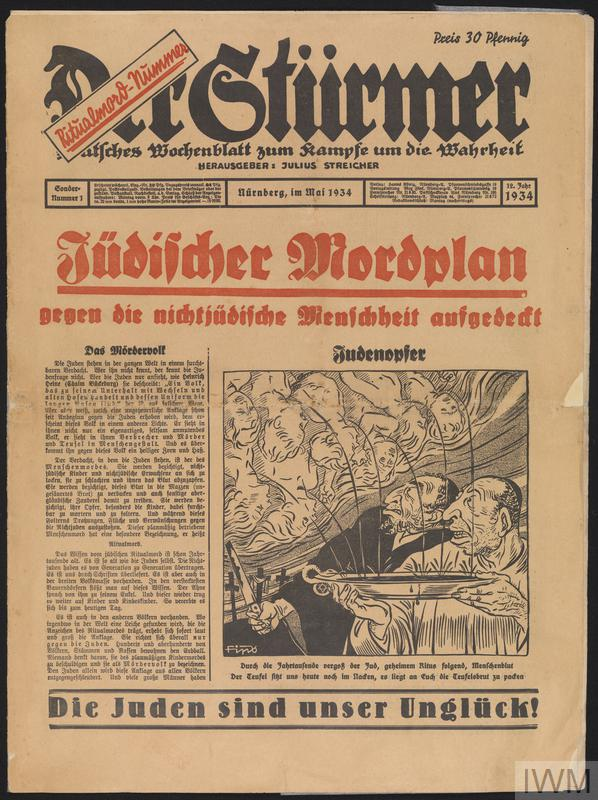
Cover of May 1934 Der Stürmer issue focused on Jewish ritual murder
However, the resonance of the Damascus ritual murder myth was not restricted to European or Christian societies. Indeed, the 1840 affair, while reported on widely in Europe, also introduced the blood libel legend into the Islamic world, where it would then take root and persist.19 After the dust settled in Damascus, the image of Jews ritually killing and consuming the blood of innocents thus found purchase in a new sociocultural and religious landscape, one in which Jews had long experienced discrimination.20 Despite every effort by Jews in Damascus and across the diaspora in refuting the story of Father Thomas’s alleged murder, in the decades that followed, blood libel accusations were increasingly levelled throughout the Ottoman Empire by both Christian and Muslim accusers, indicating that this “scourge had taken root there.”21
More than a century later, the Damascus Affair would play a key role in Syrian state propaganda, given new life by the 1983 publication of The Matzo of Zion by then-Defense Minister and Deputy Prime Minister of Syria, Mustafa Tlass.22 The Matzo of Zion, which recapitulated the events of 1840 and reiterated the ritual murder story, would go on to be republished several times and circulated widely.23 The book, like earlier Nazi propaganda, tied the alleged crime of ritual murder to the very nature of Judaism and Jews, reflected in the imagery on its jacket: in the 1983 edition, the cover displayed a gang of Jews cutting the throat of Father Thomas, but in the 1986 version, the knife at Father Thomas’s neck was replaced by a menorah.24
Mustafa Tlass argued in the book that the “horrific crime, the victim of which was Father Thomas Capuchi” was “committed by a group of Jews who wanted to extract his blood to make a matzo.” Tlass went on to argue that the investigation in 1840 “revealed serious matters that surpassed the crime itself as to the nature and motives connected with the Jewish teaching, prescribed by the Talmud, which contained destructive deviations guided by black hatred of humanity.” Moreover, Tlass framed the political campaign on behalf of the Jews of Damascus as evidence of both their guilt and of the alleged influence of global Jewry, suggesting that “Jews continue to commit individual crimes and collective slaughtering, and succeed in wiping off the evidence of their crimes by the virtue of using their financial, political, and propaganda influence in the ruling circles of Europe and the United States.”25
Importantly, Tlass’s book was written with concrete political aims, as justification for Syria’s opposition to the existence of Israel on its southwest border. Tlass castigated Egypt for forging a peace deal with Israel, in his view evidence that they “sold their national rights to the devil”, and he expressed that the Jewish establishment of “a country for themselves in the land of Greater Syria” was merely a continuation of generations of “Jewish betrayal,” an extension of the very same “Jewish hatred of others” and “hatred against humanity,” “Talmudic teachings,” and “crimes and distortions” revealed in Damascus in 1840. In furtherance of his political aims, Tlass’s reiteration of the Damascus ritual murder myth served to exacerbate hatred and distrust of Jews in Syria and across the region. This was reflected in a warning Tlass included in his book, reportedly passed from mothers in Damascus to their children: “beware of going far from your own house; because the Jews might pass by you, they might put you in their sacks and take you away to slay you and drain your blood, to make their bread of Zion.”26
The political function of this blood libel was further demonstrated by its use in United Nations proceedings. At a 1984 UN conference on religious freedom held in Geneva, former Syrian minister Maarouf al-Dawalibi launched into a tirade about the murder of Father Thomas and cited it as evidence that “The Talmud says that, ‘If a Jew does not drink every year the blood of a non-Jewish man, he will be damned for eternity.’”27 Similarly, in February of 1991, the UN Human Rights Commission in Geneva saw Nabila Chaalan, the Syrian representative, urge the international body to read Tlass’s The Matzo of Zion and champion it as a “very important work that demonstrates unequivocally the historical reality of Zionist racism.”28 This blood libel would only be condemned by the president of the UN Human Rights Commission five months after the fact, following pressure from the US and 29 other member states.29 The myth of Father Thomas’s alleged killing has thus persisted across different periods, deployed to propagandistic ends.
A Story of Solidarity
However, this is not the only way the Damascus Affair has been remembered. Indeed, the affair has also been enshrined in modern Jewish historical memory as an example of unprecedented political solidarity across the diaspora.30 This story of cross-diasporic solidarity had political and cultural power in the aftermath of the affair, furnished by the rhetoric employed during the meetings held across the West in the summer and fall of 1840, which saw Jewish community leaders expressing staunch support for their coreligionists in Damascus. For instance, at the New York meeting, Mordechai Manual Noah stressed the fraternity shared by Jewish communities around the world: in his words, “scattered by a wise Providence among every nation, we are still one people, governed by the same sacred laws and bound together by the same destiny; the cause of one is the cause of all […] and if the time has not arrived when the strong arm of Israel can once more be uplifted in defense of the nation and its rights, we can yet raise our voice.”31
Similarly, at the Philadelphia meeting, Rabbi Isaac Leeser argued that while “we have no country of our own […] we have a tie yet holier than a fatherland, a patriotism stronger than the community of one Government; our tie is a sincere brotherly love, our patriotism is the affection which unites the Israelites of one land to that of another.” Rabbi Leeser stated that it was the Damascus Affair that had “awakened anew” such fraternal sentiments, the campaign launched in response revealing that “oceans may intervene between our dispersed remnants, that mountains may divide us, but that yet the Israelite is ever alive to the welfare of his distant brother, and sorrows with his sorrow, and rejoices in his joy.”32
This emerging articulation of political solidarity would likewise be recognized by contemporaries observing the efforts of Jewish communities across the West. For instance, in response to the activities of Jewish leaders in Germany, England, and France, Washington D.C.’s Daily National Intelligencer noted how they moved “heaven and earth against the charges preferred and the cruelties perpetuated at Damascus”33 and asked, “What other body in the world would have roused and exerted themselves universally, [on] behalf of co-religionists, however treated, of a distant region, as the European Jews have done?”34
Reference to the Damascus Affair in Jewish academic discourse similarly highlighted this sense of solidarity. For instance, historian Heinrich Graetz suggested in 1870 that the affair demonstrated “how marvelous, how unbreakable is the bond which unites the Jews.”35 Historian Joseph Jacobs argued in 1902 regarding the affair that “the important thing to notice is that concerted action was taken by Jews of different nationalities” and that it represented “the first time in Jewish history since the Fall of Jerusalem [when] Israelites of different nations took counsel and action together for general defense against a common peril.”36 The theme of solidarity would likewise be reflected in discussion of the Damascus Affair in twentieth-century Jewish newspapers. For instance, columns published in The Jewish Press in 1940, marking “100 Years After the Damascus Incident”, would highlight how the crisis contributed to “unity in Israel” and how “as a result of the libel devised 100 years ago in the chief city of Syria, there developed movements which linked Eastern and Western Jewries.”37 This coverage suggested that the outcome of the affair, the “good [that] arose from evil,” was that “Jews began to think in terms of unity and cooperation, and that the various branches of world Israel were more closely knit together by the tragedy.”38
This story of the Damascus Affair, one stressing solidarity and political unity, would be invoked later in response to continuing violence against Syrian Jews. Jews in Syria faced increasing persecution over the course of the twentieth century, escalating in the aftermath of a pogrom in Aleppo in 1947. Most of Syria’s Jewish population, estimated to be around 40,000 people, fled soon after, only a few thousand remaining in Aleppo, Damascus, and the northern city of Qamishli. In 1948, Syria officially prohibited the emigration of Jews out of the country, temporarily lifting this prohibition only in 1954 and 1958 for Jews willing to leave their property behind. The remaining Jewish population was trapped. Some managed to escape illegally, smuggling themselves across the border into Lebanon or Turkey, but the journey was perilous. If they managed to evade the Muhabarat, the feared secret police, they could be killed by smugglers. Within Syria, Jews faced increasingly repressive conditions, forced to live under the constant scrutiny of the Muhabarat, who censored mail, monitored telephones, and even attended synagogue services to surveil conversations. Jewish identity cards were stamped with the Arabic Mussawi, meaning follower of Moses, and their rights to own businesses, buy and sell property, and operate cars were restricted. Throughout this period, “Jews knew that any infraction of the rules, no matter how minor, could be punished, and that Jews could not count on the courts for justice [as] there was usually no penalty for those who robbed, beat, or otherwise attacked Jews.”39

Ruins of Aleppo’s Central Synagogue, destroyed in the pogrom in 1947
Wikimedia Commons
Conditions worsened following Syria’s defeat in the 1967 Six-Day War, after which the government passed laws further restricting Jewish rights.40 These laws prohibited Jews from traveling more than three kilometers from their house without permission, imposed a curfew, limited Jews to six years of schooling, prevented Jews from working in public institutions, banks, and public service, prohibited foreigners from visiting the Jewish quarter without a government escort, prevented Jews from owning radios, telephones, or maintaining contact with the outside world, and mandated the confiscation of the property of deceased Jews by the government.41
This period also saw “wholesale attacks and state-sanctioned terror” and a “rush of arbitrary arrests and torture, public assaults, and looting” of Jewish property. Deprived of legal recourse, Jews suffering these violences knew “there was no point in turning to the police or courts for prosecution: to be a Jew in Syria was to be judged an enemy of the state.” Syrian government policy during this period further imposed barriers to Jewish emigration. Initially, the ban was uniformly enforced, preventing Jews from going abroad even for life-saving medical treatment. Eventually, the ban would be partially lifted, but Jews who managed to get permission to temporarily leave the country had to pay extortionate bribes and were not allowed to travel with family members, as family members left behind would be imprisoned if they did not return.42
In response to these worsening conditions, political campaigns were launched in the West seeking to bring awareness to the plight of Syrian Jews. In 1970, the International Conference for the Deliverance of Jews in the Middle East convened a meeting in Paris, in which a Jewish woman from Syria, masked to protect her family from the consequences of her escape, testified to the persecution of Syria’s Jews. In 1971, the World Jewish Congress in Paris published a memorandum describing the danger faced by Jews in Syria and urging their affiliates to act. A public campaign was simultaneously launched in New York by the American Jewish Committee.43
These efforts intensified in 1974, following the deaths of four young Jewish women from Damascus. In March of 1974, the bodies of three sisters, Mazal, Laura, and Farah Zebac, and their cousin Eva Saad, were discovered in a cave near the Syrian border with Lebanon, after they had been robbed, assaulted, and murdered during an attempt to escape the country. The Damascus Jewish community erupted in anger and launched a protest, one thousand community members marching out of the Jewish quarter to demand that Jews be allowed to leave Syria. After the police dispersed the protest, the Syrian government announced the arrest of two Jewish men from the community for alleged involvement in the murders, a move viewed by many within the local Jewish community and abroad as undisguised scapegoating.44

Four women killed in 1974
Clockwise from top left: Fara Zeibak, Mazal Zeibak, Eva Saad and Lulu Zeibak
Wikimedia Commons
The deaths of the four women and the subsequent arrests sparked increased efforts by Jewish organizations abroad. Some invoked the memory of the Damascus Affair to rally solidarity and support. For instance, author, activist and Jewish community leader Earl Raab, writing in the San Francisco Jewish Bulletin, directly referred to the crisis as “the Damascus Affair of 1974” and suggested that when compared with the Damascus Affair of 1840, “it will show you how little progress the Jews have made in much of the world.” Raab argued that the earlier “Damascus Affair marked the significant entry of Western Jewry into the realm of foreign affairs on behalf of world Jewry”, with their activism working to deliver Damascus’s Jews from danger. In contrast, Raab argued, “The Damascus Affair of 1974 does not have such an ending.” Reporting the story of the four women’s deaths, the community’s protest, and the arrest of the two men who reportedly “confessed” to Syrian government officials, Raab urgently asked who would help the Jews of Damascus. Without a Montefiore or a Cremieux, without support from the United Nations or the international community, who could come to their aid? He suggested “If the Syrian Jews can be helped at all, it will be by the United States” and called the Jewish community to action: “Somehow we must make the condition of Syrian Jews—as dramatized by the Damascus Affair of 1974—a serious consideration in the conduct of our foreign affairs.” To this end, Raab urged readers to lobby government officials and attend a rally on behalf of Syrian Jews, asking “Are we really more helpless in 1974 than we were in 1840?”45
This snapshot of the 1974 crisis reveals the lasting reverberations of the nineteenth-century Damascus Affair in Jewish memory. Not only a lurid tale invoked by propagandists and promoters of Jew hatred, it has also been used as a ground upon which Jews could organize against such hatred. It would ultimately take another two decades of community organizing for Syria’s Jewish community to escape oppression. Combined efforts by Jewish organizations in the US, Israel, Canada, and Britain, alongside American and Israeli government officials and Syrian Jewish community leaders, together managed to ameliorate the condition of Syria’s Jews: in 1991 and 1992, the Syrian government finally agreed to lift the ban on Jewish emigration, and nearly all 3,886 Jews remaining in Syria fled the country.46 Today, the number of Jews still living in Syria can be counted on one hand.47 Thus, “the once-proud Jewish community in Syria is no more. Synagogues that once echoed to the sound of prayer stand silent and empty.”48 Only ghosts remain.
Conclusion: 1840 and its Afterlives
Still haunting, the memory of the Damascus Affair has echoed in the nearly two centuries since Father Thomas’s disappearance. From the streets of Damascus, rumors of Jewish ritual sacrifice would go on to be reiterated in Nazi literature, Syrian state propaganda, UN proceedings, and a university classroom as recently as November of 2025. The myth has thereby been weaponized by governments and individuals seeking to justify and promote Jew hatred and received by audiences primed with pre-existing enmities. However, as I have shown, another version of the story remains powerful, one focused on the political solidarity demonstrated by many Jewish communities in 1840. This was instantiated in 1974, when the Damascus Affair was referenced as a means of rallying the American Jewish community to once again support their co-religionists in Syria, victimized in a moment of crisis, just as their predecessors had more than a century earlier. This appeal demonstrates the ongoing power of the Damascus Affair as a multifaceted symbol, invoked in both the perpetuation of and struggle against anti-Jewish persecution.
1 Leah Stein is a fourth-year PhD student in Anthropology at William & Mary. She holds a BA in Archaeology and Anthropology from the University of Oxford, and an MA in Anthropology from William & Mary. Her research area is the historical archaeology of the Sephardic Jewish diaspora. With family roots stretching back to Aleppo, she is particularly interested in studying and preserving the history of Syrian Jewish diasporic experiences and material cultures.
2 Links to audio recordings of the lecture can be found in Daniel Sugarman, “ UCL bans former employee after ‘antisemitic blood libel’ shared at campus event.” Jewish News, November 13, 2025. Accessed July 1, 2026.
3 Jonathan Frankel, The Damascus Affair: “Ritual Murder,” Politics, and the Jews in 1840 (Cambridge: Cambridge University Press, 1997), 1, 20-25, 38-9.
4 Ibid., 24-5, 37-41, 46-50.
5 Ibid., 80.
6 Ibid., 124-6, 133-4, 150-1.
7 Ibid., 214.
8 Ibid., 224; Jonathan Frankel, “‘Ritual Murder’ in the Modern Era: The Damascus Affair of 1840,” Jewish Social Studies 3, no. 2 (1997), 3-4.
9 Joseph Leon Blau and S.W. Barton, The Jews of the United States: A Documentary History, Volume 3 (New York: Columbia University Press, 1963), 930-3.
10 Ibid, 931-2; The Morning Herald (New York), 29 August 1840, page 2.
11 Frankel, The Damascus Affair, 350-3, 360.
12 Joseph Jacobs, “The Damascus Affair of 1840 and the Jews of America,” Publications of the American Jewish Historical Society, no. 10 (1902), 124-5.
13 Frankel, “‘Ritual Murder’ in the Modern Era,” 13.
14 Ibid., 13-4.
15 Ibid.
16 Raphael Israeli, Blood Libel and Its Derivatives: The Scourge of Antisemitism (London: Routledge, 2017), 56.
17 Frankel, The Damascus Affair, 430; “‘Ritual Murder’ in the Modern Era,” 15; Alan Dundes, “The Ritual Murder or Blood Libel Legend: A Study of Anti-Semitic Victimization through Projective Inversion,” in The Blood Libel Legend: A Casebook in Anti-Semitic Folklore, ed. Alan Dundes (Madison: University of Wisconsin Press, 1991), 348-9.
18 Frankel, “‘Ritual Murder in the Modern Era,” 15.
19 Bernard Lewis, The Jews of Islam (Princeton: Princeton University Press, 1984), 156; Esther Webman, “From the Damascus Blood Libel to the ‘Arab Spring’: The Evolution of Arab Antisemitism,” Antisemitism Studies 1, no. 1 (2017), 160.
20 Martin Gilbert, In Ishmael’s House: A History of Jews in Muslim Lands (New Haven: Yale University Press, 2010), 21, 32-4; Lyn Julius, Uprooted: How 3000 Years of Jewish Civilization in the Arab World Vanished Overnight (London: Vallentine Mitchell, 2018), 7-9.
21 Israeli, Blood Libel and its Derivatives, 146.
22 Dundes, “The Ritual Murder or Blood Libel Legend,” 349-50; Gilbert, In Ishmael’s House, 308-9; Israeli, Blood Libel and its Derivatives, 142, 148.
23 Webman, “From the Damascus Blood Libel to the ‘Arab Spring,’” 174.
24 Israeli, Blood Libel and its Derivatives, 148.
25 Mustafa Tlass, The Matzo of Zion (Damascus: Dar Tlass, 2010), 8-13.
26 Ibid., 12-3.
27 Cited in Frankel, The Damascus Affair, 418.
28 Gilbert, In Ishmael’s House, 308-9; Israeli, Blood Libel and its Derivatives, 148.
29 Jewish Telegraphic Agency, “Head of a U.N. Panel Makes it Known the ‘matzah of Zion’ Shall Not Rise,” July 16, 1991. Accessed July 2, 2026.
30 Frankel, “‘Ritual Murder’ in the Modern Era,” 5-6; Noah Gerber, “Can Damascus 1840 be Re-oriented? From Shami historical memory to Sephardi and Mizrahi agency,” Journal of Modern Jewish Studies 20, no. 1 (2021), 95.
31 “Persecution of the Jews at Damascus”, Evening Star (New York), August 21, 1840; Cited in Frankel, The Damascus Affair, 225.
32 The National Gazette (Philadelphia), September 2, 1840, p. 1.
33 Daily National Influencer (Washington DC), June 22, 1840, p. 2.
34 Daily National Influencer (Washington DC), September 2, 1840, p. 2.
35 Cited in Frankel, The Damascus Affair, 432.
36 Jacobs, “The Damascus Affair of 1840 and the Jews of America”, 120.
37 Philip Slomovitz, “100 Years after the Damascus Incident”, The Jewish Press (Omaha), July 12, 1940, p. 3.
38 Philip Slomovitz, “100 Years after the Damascus Incident”, The Jewish Press (Omaha), July 19, 1940, p. 3.
39 Harold Troper, The Rescuer: The Amazing, True Story of How One Woman Helped Save the Jews of Syria (Toronto: Lester, Mason & Begg, 2007), 1-3.
40 Ibid., 26-27; Gilbert, In Ishmael’s House, 303.
41 Gilbert, In Ishmael’s House, 303.
42 Troper, The Rescuer, 26-29.
43 Gilbert, In Ishmael’s House, 304-5.
44 Troper, The Rescuer, 80-81; Gilbert, In Ishmael’s House, 306.
45 Earl Raab, “Candid Comments,” San Francisco Jewish Bulletin, April 19, 1974, p. 4.
46 Troper, The Rescuer, 227; Gilbert, In Ishmael’s House, 308.
47 Justice for Jews from Arab Countries, Report on the Jews of Syria: Historical and Economic Analysis (New York: JJAC, 2024). Accessed July 2, 2026.
48 Troper, The Rescuer, 227.
Copyright by Sephardic Horizons, all rights reserved. ISSN Number 2158-1800