
Kateřina Králová
HOMECOMING
Holocaust Survivors and Greece, 1941-1946
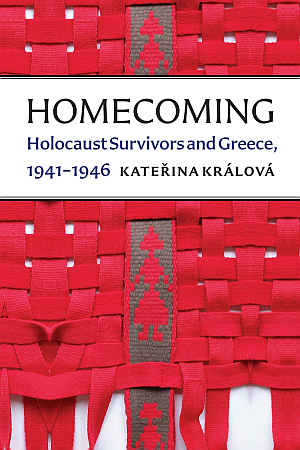
Brandeis University Press, 2025, ISBN-13: 9781684582570
Reviewed by Judith Lin1
Homecoming: Holocaust Survivors and Greece 1941-1946 by Kateřina Krávolá presents an incredibly important and understudied analysis of the trajectories of homecoming on the part of the Greek Jews who survived the Holocaust. This publication is based on over ten years of examining survivor accounts through multiple archives, including the Visual History Archive of the USC Shoah Foundation, the Fortunoff Video Archive for Holocaust Testimonies, the Yad Vashem Archives, and the Jewish Museum in Athens, Greece. The book shows that Krávolá’s personal interest lies in storytelling as a means to humanize larger historical and political events. She elegantly weaves together narrative vignettes, conceptualizing the stories representing people who were either internally or externally displaced during the Holocaust. Homecoming transcends typical characterizations of the war, offering a holistic, interconnected system as a way to conceptualize survivors’ trajectories during and after the Holocaust.
This book takes methodological inspiration from Tim Cole, attempting to reveal “unwritten layers of history” (p. 11).2 Krávolá’s research shows that Holocaust displacement was characterized by loneliness, deprivation, hostility, and anguish (p. 1). Chapter One uses geography as the framework to look at experiences from survivors returning to Athens, Thessaloniki, the smaller, overlooked communities of Alexandroupoli, Drama, Kavala, Komotini, Serres, Xanthi, and Xakynthos. Krávolá doesn’t just focus on statistics or quantifiable data, instead she puts names and personal stories to help her reader track the movements and motivations of the survivors’ return to each of these places. Her analysis humanizes the experiences, while also honoring the stories and personalities of specific people, differentiating between their personal, emotional motivations:
While Laura stayed behind in Greece to care for her mother, who was mourning for her deceased daughter and husband…Sarah, a self-confident teenager, decided to leave to help build a new Jewish homeland in Palestine… (p. 37).
Details and characterizations such as this help to give depth and color to historical events.
Chapter Two continues in the same scholarly yet caring tone through the lens of the people who decided to join the partisan movement against the Nazi invasion. It has often been speculated why so many Greek Jews died and why they seem to not have resisted. Krávolá speaks to these concerns without giving credence to any unjust criticism:
Since openly disobeying wartime measures would most likely have been met with the death penalty, individual decisions about going into hiding, let alone taking up arms in resistance against the Nazi rule, seemed to pose a much higher risk… (p. 48).
The partisans and those that survived through hiding in Greece caused a social rift after the war between the different groups of survivors, lending insight into the social disruption that was experienced post-Holocaust.
In Chapter Three, Krávolá discusses the experiences of homecoming from the lens of different concentration camps from which survivors emerged. Testimonial accounts from survivors from Treblinka, Auschwitz-Birkenau, and Bergen-Belsen are interwoven in the text. Krávolá focuses on accounts that describe the psychological and emotional effects and reception upon returning to Greece:
The question is almost asked, ‘Why are you alive and not my relatives—my mother, my father, sister, and so forth? This led to the untrue generalization on the part of community leaders that only the worst elements of the Jews survived the concentrations camps (p. 90).
Králová’s interconnected system of examining these narratives reveals once again why social integration may have been so difficult for survivors after the war. Her work also takes inspiration from Carol Kidron’s research on survivors and their decedents, and although Krávolá doesn’t make direct assertions about survivors and their children; her ideas are clearly in dialogue with Kidron, Bukiet, and others who have tried to verbalize the relational difficulties experienced by survivors’ families.3
Chapter Four addresses the experiences of individuals who were abroad during the war, but tried to come back to Greece afterwards. Krávolá suggests that these refugees had the most shocking return out of all of the other groups, explaining that
They were now seen as foreigners in Greece, impoverished intruders, and above all, unwanted Jews pouncing on the property already appropriated by others” (p. 173).
Krávolá confirms in the conclusion of this short chapter that refugee narratives contradict mainstream Greek mythologies surrounding acceptance and unification of Greek nationals after the war. In conclusion, Chapter Five discusses the aftermath of homecoming in Greece, particularly the disputes regarding property and real estate. Even though the policies in Greece stated that property had to be equitably returned, including that which had been “Aryanized” the practice of this was often experienced as a betrayal of goodwill (p. 180).
In these ways, Krávolá brings nuance to understudied aspects of survivorship which otherwise would be left to assumption, generalization, or misunderstanding. The structure of the book is masterful in that it allows a multiplicity of voices to explain unvoiced questions that arise about the disparities of the Holocaust experience. Her discussion on homecoming is of particular importance because as she mentions, the Adolf Eichmann trial underrepresented the stories of Sephardic Jews. In addition to this bias of representation, Greek narratives of patriotic heroism tend to brush past the experiences of the Greek Jews who did not receive the welcome they would have hoped for upon their return to their homeland. I wholeheartedly recommend this book both for its academic rigor and evident tenderness in handling these stories. The bibliography alone is a treasure for future academic study. It was an honor to read this book.
1 Judith Lin is a writer and researcher of the Sephardic Holocaust experience. She is currently a fellow at the Fortunoff Archive at Yale University. Judith completed her PhD as a Rachel Winer Manon Jewish Studies fellow at the University of Virginia. Her first monograph, Belonging to Exile: Sephardic Homelands through Poetry (Bloomsbury 2026) discusses the different national geographies that appealed to Sephardic Holocaust survivors after the war.
2 Cole, Tim. Holocaust Landscapes. London: Bloomsbury Continuum, 2016.
3 Kidron, Carol A. “Sensorial Memory: Embodied Legacies of Genocide.” A Companian to the Anthropology of the Body and Embodiment, Frances E. Mascia-Lees, ed. 451-66. Chichester: Blackwell, 2011. Bukiet, Melvin Jules, ed. Nothing Makes You Free: Writings by Descendants of Jewish Holocaust Survivors. W.W. Norton & Company, 2002.