
Matthew D. Warshawsky
FROM NEW CHRISTIANS TO NEW JEWS
SEVENTEENTH CENTURY SPANISH TEXTS IN DEFENSE OF JUDAISM
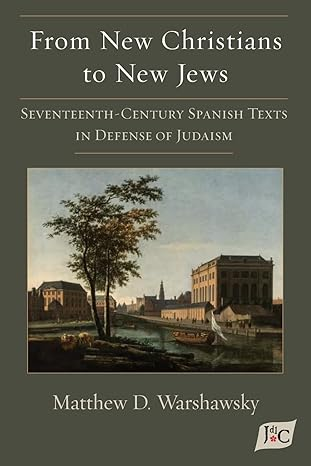
Newark, Delaware: Juan de la Cuesta Hispanic Monographs
Linguatext, LLC, 2024. ISBN 978-1-58871-405-3
Reviewed by Shai Cohen1
What does it mean to be Jewish when Judaism itself has been erased from the land of your birth? This is the animating question behind Matthew D. Warshawsky’s rich and rewarding study, From New Christians to New Jews: Seventeenth-Century Spanish Texts in Defense of Judaism, published in 2024 as the tenth volume of the Juan de la Cuesta Estudios judeoespanoles series. Warshawsky, professor of Spanish at the University of Portland and a scholar of Jewish and converso literature in the Iberian world, offers an elegant and persuasive argument: that six seventeenth-century New Christian authors, Isaac Orobio de Castro, João Pinto Delgado, Antonio Enríquez Gómez, Isaac Cardoso, Miguel (Daniel Levi) de Barrios, and Daniel Israel López Laguna, belong to the mainstream of Spanish Baroque literature even as they used its conventions to assert a Judaism that the Iberian Inquisitions were actively trying to extinguish.
The book will be of particular interest to readers of Sephardic Horizons on several counts. It brings sustained literary-critical attention to figures who are typically approached as historical curiosities rather than as serious authors in their own right. It situates Sephardic writing within the broader currents of early modern European literature. And it does so with genuine warmth for its subjects, tracing across six chapters the intellectual and spiritual journeys of men whose very identities were crimes in the countries that formed them.
The expulsion of the Jews from Spain in 1492 and their forced conversion in Portugal five years later set in motion a diaspora that would scatter converso communities across the Atlantic world and the Ottoman Empire for generations. Warshawsky’s introduction carefully maps this geography (Amsterdam, Venice, Livorno, Bordeaux, the Caribbean, Brazil, London, Jamaica), reminding readers that these were not marginal outposts but vital nodes of commerce, culture, and Jewish renewal. Amsterdam, to which five of the six authors in this study had direct connections, emerges as the gravitational center of this dispersed world: the city where, as Warshawsky notes, “conversos established the most important center of such returnees to Judaism in northern Europe” (p. 16) during the 1600s.
The book's central scholarly intervention is to reframe these authors not primarily as crypto-Jews or religious polemicists but as practitioners of Baroque Spanish literature writing outside the inquisitorial sphere, though never free from its shadow. Warshawsky carefully demonstrates that his subjects composed sonnets, epic poems, narrative ballads, theological treatises, and at least one allegorical play using the literary conventions of the Spanish Golden Age, and that reading them through this lens reveals dimensions of their work that a purely religious or biographical approach would miss.
This argument builds productively on the scholarship of Miriam Bodian, Yosef Kaplan, Kenneth Brown, Timothy Oelman, and others who have studied converso writers of the post-1492 era. Where Warshawsky adds most distinctively to this conversation is in his consistent attention to genre and form. He asks not only what these authors said about Judaism but how the literary forms they chose, the elegy, the romance, the auto sacramental, the paraphrase of Scripture, shaped what they could say and how they said it.
Chapter One examines Isaac Orobio de Castro, the Portuguese-born physician and formidable Jewish apologist. Warshawsky analyzes Orobio’s letters written in 1663–1664 to his fellow former New Christian Juan (Daniel) de Prado, whose deism placed him outside Amsterdam’s Jewish community, and two anti-Christian tracts addressed to Protestant and Catholic opponents. The central irony is elegantly drawn: Orobio’s deep knowledge of Christianity, acquired under inquisitorial pressure, became the very instrument with which he defended Judaism.
Chapter Two turns to João Pinto Delgado, a poet whose elegies and biblical paraphrases were published in Rouen in 1627, years before he could openly profess the faith whose loss they mourned. Working with poems drawn from the books of Esther, Lamentations, and Exodus, Warshawsky demonstrates how Pinto Delgado used the conventions of Spanish court poetry, including allusions to Jorge Manrique and Luis de Góngora, to communicate a specifically Jewish sorrow and longing that would have been invisible to most of his Spanish readers while unmistakable to fellow conversos. The chapter is a model of close reading, finding in the interstices of Golden Age lyric a hidden language of exile.
Chapter Three, on Antonio Enríquez Gómez, is in some ways the most surprising in the book. Enríquez Gómez was the only one of Warshawsky’s six authors to return to the Iberian Peninsula, making his case an unusually pointed demonstration of the book’s argument about Baroque Spanish literature and Jewish identity coexisting in a single sensibility. Warshawsky examines three poems from the author’s French exile to show how Enríquez Gómez used them not as confessional Jewish texts but as platforms for advocating the values of tolerance, free will, individual conscience, that his family’s experience with the Inquisition had taught him to prize. The chapter wisely avoids reducing the poetry to biography, even while making clear how powerfully the biographical context shapes the poems’ urgency.
Chapter Four addresses Isaac Cardoso and his landmark prose work Las excelencias de los hebreos (The Excellences of the Hebrews), published in Amsterdam in 1679. Cardoso’s strategy, to catalog ten “excellences” of the Jewish people and then refute ten common slanders against them, was a response to a world in which Judaism no longer officially existed on the Iberian Peninsula. Warshawsky considers this text through a Spanish-Portuguese lens, showing how Cardoso’s awareness of the converso experience, and of the unjust treatment of Jews and New Christians under the inquisitions, deepened his commitment to a Judaism that he had been able to practice openly for half his life. The analysis of how Cardoso’s converso background shaped his understanding of Jewish identity, making him simultaneously insider and outsider, practitioner and scholar, is among the book’s most intellectually satisfying passages.
Chapter Five examines Miguel (Daniel Levi) de Barrios, the most prolific and in some ways most flamboyant of Warshawsky’s subjects. A soldier, a courtier, and eventually a poet of the Amsterdam Sephardic community, Barrios moved between Catholic Spain and Jewish Amsterdam in ways that left unmistakable traces on his writing. The chapter focuses on his allegorical play Contra la verdad no hay fuerza (Nothing Can Stand Up to the Truth), written in Amsterdam in the late seventeenth century, which Warshawsky interprets as a remarkable instance of formal subversion; Barrios takes the auto sacramental, a genre developed primarily to celebrate the Eucharist, and uses it to affirm not the body of Christ but the covenant of the Jewish people. The auto had always been about transformation and sacrifice. Barrios redeploys it in honor of three conversos martyred in an auto de fe in Córdoba in 1665. The irony, an “act of faith” answered by an act of faith, is as pointed as anything in the period’s literature.
Chapter Six considers Daniel Israel López Laguna’s paraphrase of the Psalms, Espejo fiel de vidas que contiene los Psalmos de David en verso (Faithful Mirror of Lives That Contains the Psalms of David in Verse), published in London in 1720 after a life that had taken López Laguna from the Iberian Peninsula to Jamaica, Barbados, and eventually England. Warshawsky reads this text as the chapter most emblematic of the transatlantic reach of the Spanish-Portuguese Jewish diaspora. The figure of the peregrino, the wanderer, runs through López Laguna’s Psalms, as it does, Warshawsky argues, through the lives and literature of all six authors, and it becomes a theological category as much as a biographical fact: perpetual displacement transformed into a sign of divine election.
The book’s greatest strength is the consistency and rigor with which Warshawsky applies his framework across six very different authors writing across roughly seventy years of Sephardic diaspora history. Each chapter stands as a self-contained study that could be read independently, yet the accumulation of cases across the book builds an argument that is more persuasive than any single chapter could be. By the time one reaches the conclusion, the claim that these authors constitute a coherent, if dispersed and varied, tradition of Baroque Jewish literature feels richly documented.
The attention to form and genre throughout is admirable and relatively unusual in the scholarship on converso and New Jewish writing, which has more often prioritized historical reconstruction over literary analysis. Warshawsky never loses sight of the texts as texts: the way a sonnet’s volta can function as an act of theological assertion, the way an epic poem’s classical allusions can shelter a hidden confession of faith, the way the dramatic conventions of the auto sacramental can be turned inside out to serve an entirely different theology. This is literary scholarship at its most useful.
The book is also genuinely useful as an introduction to figures who remain underappreciated outside specialist circles. For readers who may be familiar with Orobio de Castro or Cardoso as historical figures but have not encountered sustained analysis of their writings as literary productions, Warshawsky provides both the context and the close reading necessary to appreciate what makes these texts distinctive. The translations of Spanish and Portuguese passages throughout will make the book accessible to readers who do not work in those languages.
No book this ambitious can escape entirely without raising questions that it does not fully answer. One concerns the selection of authors. The field of converso and New Jewish writing is significantly larger and well-studied. The absence of any extended consideration of women writers in this tradition, or of authors working in Portuguese rather than Spanish, is noticeable. The author acknowledges that his study cannot be exhaustive, but a more explicit engagement with the principles of inclusion and exclusion might have strengthened the book’s theoretical framing.
A related question concerns the book’s use of the category “New Jew.” Warshawsky follows Yosef Kaplan in using this term to describe Iberian conversos post-1492 who, despite having practiced Jewish rites incompletely or not at all in Spain and Portugal, became openly practicing Jews in Sephardic communities outside the Iberian Peninsula, especially in Western Europe during the seventeenth century. This is a useful and well-established category, but it brings with it complexities that the book does not always pause to address. The question of what it means to become a “New Jew” (as opposed to a returned Jew, reverted Jew, or a reconstituted Jew, or simply a Jew) touches on issues of authenticity, rabbinic authority, and communal acceptance that press against several of the texts Warshawsky analyzes, most obviously in the case of Orobio’s polemics against Prado.
There are also moments when the book’s emphasis on the Spanishness of its subjects can feel slightly at odds with its argument about the Jewishness of their writing. To demonstrate that Pinto Delgado was deeply formed by the conventions of Spanish Golden Age poetry is important and true; it is also the case that the Psalms he paraphrased, the lamentations he echoed, and the exodus he invoked belonged to a literary tradition at least as powerful as Góngora’s. The book generally navigates this tension well, but there are passages where the Jewish intertextual dimension of the texts, their engagement with biblical narrative, rabbinic interpretation, and the liturgical traditions to which the authors had varying degrees of access, might have received more sustained attention.
These reservations do not diminish the considerable achievement of From New Christians to New Jews. Warshawsky has written a book that is simultaneously a work of careful literary scholarship and an act of recovery, an effort to restore to the canon of Baroque Spanish literature six writers who have too long been treated as footnotes to history rather than as authors deserving of serious critical attention in their own right. The conclusion, which draws on Henry Kamen’s phrase about the converso diaspora as a “virtually endless history of restlessness,” situates the book’s six subjects within a larger arc of Sephardic resilience that, as the author notes, continues to resonate today (p. 190).
Warshawsky ends by saying that the opening in 2012 of the Isaac Cardoso Interpretation Center of Jewish Culture in Trancoso, Portugal, and the establishment of a synagogue there at the request of local descendants of conversos, testify to the living legacy of the faith these six authors championed. It is a reminder that the history of Sephardic literature is not only a matter of archives and critical editions. It is a narrative that is still being written. From New Christians to New Jews makes a genuine contribution to that ongoing story, and it deserves a wide readership among scholars of early modern Spain and Portugal, historians of the Jewish diaspora, and anyone with a serious interest in the Sephardic world.
1 Shai Cohen is Senior Lecturer in the Department of Modern Languages and Literatures and Director of Sephardic Studies at the University of Miami. He holds a Ph.D. in Hispanic Literature from the University of Navarra. His research focuses on early modern Spanish literature, Sephardic studies, Judeoconverso identity, and digital humanities.